The Surfer’s Journal is proudly reader-supported since 1992. We rely on membership rather than advertising to remain commercially quiet. Become a member below and gain access to every article ever published along with many other TSJ member-only benefits.
Create a free account to access three complimentary articles, or become a member to unlock all editorial and become a supporter of independent surf journalism.
Subscribers to The Surfer’s Journal get access to all our online content as well as the TSJ archive. Become a member to unlock all editorial and become a supporter of independent surf journalism.
In search of Dane Reynolds. The famously elusive surf god has never been more available—or more open. Still, his enigma endures.
Words by Tony John Andrews | Portraits by Corban Campbell
Feature
Light / Dark
In November 2024, I made the five-hour drive from Santa Cruz, where I was living at the time, down through the yellowy hills of California’s Central Valley, swerving past tumbleweeds and stopping only to piss behind a gas station whose restroom was out of order, and arrived in Ventura just in time to watch Dane Reynolds open up a surf shop. I had no idea how he’d receive me. He’d been ghosting my texts for the past week.
Despite his reputation for being aloof, Dane has never been easier to find. Just plug 83 South Palm Street into Google Maps and follow the pleasant woman’s voice downtown to a windowless, brutalist structure that looks like a cross between a cruddy old high school and a prison—except the rightmost end has been freshly painted white. There, above the entrance, you’ll find a cryptic name stenciled in minimalist font: “CHAPTER 11 TV.” This, the Google Maps listing will tell you, is the ironic “global” headquarters of the only surf shop of its kind in the world.
It’s here that you can find him—one of the greatest, most influential surfers of the modern age—working the register, screen-printing T-shirts, editing surf videos, taking out the trash, scraping human shit off the back stoop, and draining crisp Coors Lights with a ragtag crew of young local rippers he’s dubbed the “Academy of Idiots.” You can visit him between the rough hours of 11 a.m. and 5 p.m. from Tuesday to Sunday most weeks, with the occasional “gone surfing” note taped to the door when the waves finally get good. Just don’t tell him I told you—or do. It’s hard to tell if he’d care.
For readers who either don’t follow surfing or have spent the last 20 years in a cryogenic chamber, Dane Reynolds ringing people up at his very own hometown surf shop is like if Michael Jordan ran a shoe store in North Carolina, where he spent his days measuring random customers’ feet. Perhaps more accurately, it’s like if Allen Iverson did that. Basketball’s “AI” was the reason a generation of ballers wore giant shorts and braids and chains, and played the game by streetball rules.
Likewise, Dane was surfing’s anti-star, the irrefutable talent who refused to conform to pro surfing’s established playbook, embodying the archetype of the reluctant hero we can’t seem to help but adore. How did it happen?
Following his early 2000s breakout parts as a teenager in Young Guns I and II, he made his solo film debut in First Chapter (2006), which launched his surfing star for two reasons.
The first: It subverted the conventions of the surf-profile genre. Originally conceived by Quiksilver’s marketing team as Great Dane, complete with a talking dog mascot (it’s difficult to fathom a gimmick more offensive to the Dane we know), First Chapter represented his inaugural effort to wrest control of his own image. What he created, at just 20 years old (he couldn’t even legally drink at the film’s Huntington Beach premiere), was a smart, sarcastic film within a film that cast him as a tortured auteur at the typewriter and in the editing bay, obsessed with doing something new in a world where everything had already been done. “Nothing’s original anymore,” he laments through his typewriter’s keys in the film’s intro. “Claymation’s been done. Skits are lame. I can’t act.” Director Jason Muir tries to help: “You’ve gotta be honest,” he says. “But honesty needs to be provoked,” Dane insists, ironically creating a truly honest moment, and flashing a level of characteristic insight you might not expect from a kid who dropped out of high school to surf.
Dane’s postmodern, deconstructed approach to the film might have failed or come off as pretentious were it not for reason number two: He ripped. It’s been said that Kelly Slater was on a plane when he popped the DVD into his laptop, sat spellbound for the film’s full 40-minute runtime, and announced at its conclusion, “That’s the best surfing I’ve ever seen.”
Altogether, First Chapter set up the defining contrast that would make Dane’s persona so singularly compelling: virtuosic talent combined with a live, conflicted mind. Everything about him seemed a contradiction. Despite his apex skill, he approached lineups like a bottom-feeder, picking off scraps while lesser surfers claimed the sets. He never won a major contest. He loathed competition—it gave him clinical panic attacks—but rose as high as fourth in the world, then announced he was quitting the tour in his “Declaration of Independence,” an eccentric blog post in which he compared himself to a sweater.
In general, he seemed allergic to the commercial aspects of surfing, dodging his sponsors’ marketing asks and using awards speeches to deliver deadpan stand-up routines. Yet he still commanded record deals, with Quiksilver shelling out more than $20M over the course of eight years just for his reluctant association.
Despite his substantial corporate backing, he took his marketing into his own hands, portraying himself in the style of the underground bands he loved. He was one of the first very surfers to recognize and successfully leverage the democratizing power of the internet: With the help of his longtime filmer, Jason “Mini” Blanchard, he built a rudimentary blog, gave it a subtle, evocative name—Marine Layer Productions—and published remarkable little film-poems of his otherworldly skills set to music the surf world didn’t know existed. Between 2010 and 2016, Marine Layer assembled a corpus of videos that blended avant-garde aesthetics with razor’s-edge surf performance and came to define not only the prime of Dane’s career, but the look of surf films to this day.
Critics called him a lazy hipster who was squandering his talent. To the fans who drowned them out, he was a god. In his image, they sported DIY bowl cuts, shot shaky Super 8 film, scribbled in Sharpie all over their boards, and let their back-zip pull cords flap in the wind. In musical terms, he was surfing’s Kurt Cobain, but without the heroin or (thank God) the shotgun—the rarefied case of counterculture meeting pop acclaim. Like Cobain, he dodged the spotlight, resisted mainstreamization, and, by the upside-down logic of reversed effort, was sought after and beloved all the more.
In 2015, Dane’s career took a right turn when Quiksilver filed for Chapter 11 bankruptcy in the US. Still, they offered him another $9M over six years to don their trunks. He turned down the guaranteed money and endeavored instead to found a new brand in collaboration with like-minded peers—Craig Anderson in surf, Austyn Gillette and the late Dylan Rieder in skate—under the idyll of “rider owned, rider operated,” which sounded awesome in theory but in practice meant a bunch of surfers and skaters trying to do something that requires planning.
They christened it Former, a name that functioned as both an ironic embrace of their fallen status and a noun of the verb “to form,” as in “something that remakes itself”—a suggestion of a latent evolution. At the time, Dane was beginning to feel the first chafes of the slow, agonizing erosion of his surf skill, dulled by age, and the shine—as former Quiksilver CEO Pierre Agnes had chastised Dane before the crash—of the sport’s younger rising stars. “You used to be my kid’s favorite surfer,” the big man had told him. “Now it’s John John. If you don’t get it together, we’re all fucked.”
Also around that time, Dane shuttered Marine Layer. His clips became scarce. Everyone missed watching the way he rode waves. On the bright side, Former’s 2017 first drop went gangbusters, sold out, and made $60K in a single day—but then there was nothing left to sell. Surfing doesn’t teach you how to manage a retail calendar.
Suddenly, Former was $70K in credit card debt, on the verge of collapse. Dane moved the company into his garage and put it on life support, running it by hand—screen-printing merch, making shipping labels, answering customer emails. Inventory was such a mess that he shipped customers whatever was on hand instead of the items they had ordered. “They won’t care!” he told himself. They cared, and it took him months to unravel the mess while helping to raise his three kids under 5. He was surfing less than ever.
Through a year and a half of sheer stubborn will, Dane managed to get Former into the black, then hired a management consulting firm to oversee operations from there. Physically, he was, in his own words, “fossilized,” and he hadn’t put out clips in years.
Enter Chapter 11 TV in 2020, a new platform Dane understatedly describes as “surf videos on the internet,” where he makes and posts stylized, irreverent videos of himself and the academy—headlined by Eithan Osborne, 25; Jake Kelley, 30; and Micky Clarke, 27—groveling the “Shit Waves” (as the channel’s banner series is titled) around Ventura, with the help of friend and filmer Hunter Martinez, 30. In 2022, Dane opened Chapter 11’s first brick-and-mortar shop, selling branded merch to pay Martinez to spend his days lugging a tripod around the beach. It was a little white shack with green shutters that got bulldozed, so Chapter 11 relocated to the weird commercial spot on South Palm, which brings us to today.
This has been Dane’s life for the past three-plus years: actively running a mom-and-pop storefront. It seems like a curious choice for a man who’s made tens of millions of dollars in his career and suffers from clinical social anxiety. Perhaps even more surprisingly, a different Dane has begun appearing with greater frequency in the surf media, more candid and at ease, denouncing his old self as “a brat,” “a dickhead,” “such a fuckin’ asshole,” and “a bitch.”
I wanted to know what had changed, and how, as well as to fill in the gaps of his story. I wanted to understand the secret behind his mystique—was it constructed or authentic? Both? Neither? I wanted to know if he regretted quitting the tour, turning down many millions more in sponsorship deals, and never winning the world title to which his talent so obviously entitled him. I wanted to know where he was going, what was left, and how he felt about it all.
•
If you had told me in 2010, when I was sitting in the back row of a classroom amid the bleak winter of a Massachusetts valley, surviving a tedious lecture only by the grace of a Marine Layer video playing in split-screen beside my notes, that I would one day be commissioned to pen a profile on Dane Reynolds, I might have spasmed, leading my classmates to suspect I was enjoying another kind of popular internet video. I was a bored middle-class kid on a soul-crushing treadmill of studying and swim practice who, inspired by Marine Layer, taught myself to surf in the rare chances I got in the piddling windslop of New England. I could see my whole dead future spread out before me: Finish college, get a job, and spend the best years of my life in a gray office, manipulating spreadsheets on a computer while my body and soul crusted over. With its DIY, anti-establishment ethos, Marine Layer was a portal to a shining blue calling I was certain I’d missed, Dane the surfer equivalent of a punk band that vented all my juvenile angst.
Celebrity worship is embarrassing, but Dane was the kind of celebrity who seemed to agree. It wasn’t just me—his influence extended to peers and rivals alike. No writer has spent more time with Dane than Travis Ferré, who recounts how, on a trip for the epochal high-performance surf film Modern Collective (2009), which showcased an array of the era’s most electric freesurfers, Dane was in the habit of wearing a favorite denim button-down shirt every day. Sure enough, over the course of their time together, every other surfer on the trip magically procured denim shirts of their own. “[Dane] freaking ripped and we all wanted to be him.…Even Jordy Smith—who at the time was in a man-on-man duel for gnarliest up-and-coming surfer with him—was in awe,” Ferré writes. “‘Bru, where can I get a denim jacket?’ I remember him saying.”
If Dane is reading this now, I’m certain he’s cringing. (And if not, then he definitely is now.) And rightly so. That is, of course, how any true original would react to such shameless adoration. But Dane, you have to understand: You were just too cool. Internet slang today calls it “aura”—the almost visible glow that seems to surround people of a certain destiny. It’s the kind of thing that’s impossible to define, but you know it when you feel it. All the greats have it: Miles Davis in jazz, Lou Reed in rock, Messi in the beautiful game. But surfing is the proverbial “sport of kings” and, when enacted at the high-performance level, the most aura-laden act. It’s the coolest thing in the world.
No one surfed cooler than prime Dane, whose displays evoked the words of literary great David Foster Wallace: “Jordan hanging in midair like a Chagall bride, Sampras laying down a touch volley at an angle that defies Euclid.…There is about world-class athletes carving out exemptions from physical laws a transcendent beauty that makes manifest God in man.” Add to this list: “Dane Reynolds digging into a grab-rail cutback that rips the fabric of space-time—or launching a reckless full rotation 6 feet above the lip and casually sticking it, without a twitch of recoil, as though the forces of physics bend to him.”
The cliché way to compliment a great athlete is to say he performs “like a video game,” but it’s a bad comparison. For all this talk of computers taking over, video-game graphics still haven’t managed to replicate the organic fluidity of real human motion that great performers exude. Dane surfed better than a video game. “I selfishly wished he liked competing more,” Kelly Slater wrote to me, “because I thought he lent a lot of credibility to the talent on tour.”
Dane captured what we all wanted to see ourselves doing on a board, an effect heightened by the fact that most of his videos were shot in sloppy backyard California waves his talent made look like a racetrack. He was all top-to-bottom, pinballing speed, power, projection and air, explosion and yo-yoing momentum and thrashing yet elegant limbs. He seemed to push every turn to its apex or beyond, often submerging his entire body into the wave, yet somehow always rode out. He claimed nothing. Not a joule of wave energy was wasted. The edge he buried, spray he lashed, and strata he climbed seemed to cry out to our angriest, most beautiful wishes.
Greedy surf fans that we are, we wanted more of him than he was willing to give. “I hate doing interviews,” he told Monster Children in a rare 2020 sit-down, smirking and shrugging at the contextual irony of it. “When you repeat over and over what you think and how you feel, you lose touch with it. You don’t know if you feel that way anymore. It starts to feel like you’re playing a character.”
•
In mid-May of 2024, my editor made first contact with Dane to propose the idea of this profile. “He was fast replying out of the gate on texts,” my editor wrote to me, “then he trailed off…radio silence since.”
We let it simmer for a bit. This is a tricky part of doing celebrity journalism: getting access to big subjects without being served a restraining order. On August 8, my editor forwarded me a reply from Dane:
Yeah let’s make it happen! What’s best way? I’ve been out of town not on a surf trip and need a surf trip so will probably continue to be busy for next month, where’s he based out of?
Talk soon
Dane
I knew this already—the part about him being out of town, “not on a surf trip.” His wife, Courtney, had been Instagramming their road trip with their three young kids from California through the Mountain West and back. They went tubing in Idaho, were underwhelmed by Mount Rushmore, spotted a bighorn in the Badlands, watched the freight trains sweep across the Great Plains.
The whole thing looked whimsically idyllic. Dane made occasional cameos—lounging by a river, standing on a log overlooking an alpine lake. It was strange to see him away from the ocean. It gave the effect of a wingless bird. It was also strange, I was aware, to be cyberstalking a family I do not know.
My editor gave me Dane’s number and email to get the ball rolling. So, three months after the initial outreach, I made first direct contact.
Hey Dane, I texted, introducing myself. I think it would be best to do the reporting when the new shop opens. Do you have an expected date?
Three hours later, my phone glowed surreally with his name.
Let’s chat tomorrow, he wrote. I’ll just be editing a video.
I called him the next day. No response. I texted him, then followed up two days later. This time, he replied right away.
Sorry. Shooting for oct 19th.
Thanks for the intel, I wrote back. Let’s keep in touch as the date approaches, and I’ll be on hand if that works for you.
Thanks! Ya just editing a film we’re releasing on that date. I’m all scrambled. So sorry for lack of response
No worries, would you mind jumping on a call real quick?
My phone lit up.
“Hey, Dane.”
“Hey!”
I summarized the plan: visit the shop opening, shadow him a bit, see him surf, et cetera.
“Sure, I’m easy!” he said to everything, but I could hear the reluctance of an upward inflection in his voice. He was either being incredibly cheerful and agreeable or just saying yes so he could brush me off the phone.
September passed in a blur. On October 2, I checked in.
Still tracking for 10/19?
7/2 now.
Next July?
Ha! Sorry. 10/2.
So…today?
Goddamn it. 11/2 November.
Hahaha.
All over the map. Sorry.
Then it was 11/9 (apologies we hopped on a surf trip aha), then 11/16. A week out from 11/16, I reached out to check if the date had held. Silence. On the day of, still nothing. But the Chapter 11 Instagram confirmed that the opening was still on, in conjunction with the world premiere of the film Dane had been busy editing, Skinny Meat Head (spelled like that, with “meat” and “head” as two separate words), a profile of Chapter 11’s golden boy, Eithan Osborne, whom many locals believe has the talent to take up Dane’s mantle as the next great Ventura ripper.
Skinny Meat Head was to be the most substantial study Dane has ever made of another surfer, with the single exception of 2013’s Slow Dance, starring Craig Anderson. Dane was in his prime then, and Ando is among his best friends. By contrast, Skinny Meat Head seems to mark a definitive gear shift for Dane, whose cherished surf presence has become increasingly rare in Chapter 11 videos of late. And lo, a common refrain has emerged in the comments section, echoing the chorus of his whole career:
“More Dane, please.”
•
Seeking that, I arrived in the cool autumn dusk at Chapter 11. An ignorant passerby would have no idea that the shop had anything to do with surfing—or that it was even a store. Overhead, a rusty signpost held aloft a light box emblazoned with red vintage script—“Legion Lounge Welcomes You”—a relic of the building’s postwar past as a watering hole for veterans. An L-shaped privacy wall concealed the entrance, which gave the place the feel of a speakeasy. I stepped inside.
The shop was a large, open-floor space with stripped-down, postindustrial vibes—acid-washed concrete floors, exposed wooden beams, fluorescent tube lights. The front was sparsely populated with merchandise: spartan, with small, understated logos, or adorned with one of Dane’s scratchy sketches (like a childhood drawing of Tom Curren riding waves from Feral Kingdom) or some ironic bit: “Reynolds Beer Removal Service: Crushing Cans Since 1985” (the year he was born).
At the register was a bookshelf stuffed with classic surf films on VHS and DVD, most from Dane’s personal collection. The walls were lined with CI boards or wheat-pasted over with a collage of black-and-white film photographs that formed a kind of punk-zine mosaic retrospective of his career—shots of huge airs and massive arcs, Dane posing with a midget Kiss cover band.
The spaces in between were sprinkled with weird little bits of ephemera: an antique gold-framed mirror, bright colored-marker drawings by Dane’s kids, a “Chapter 11” neon sign in the Coors Light font. On the wall beside the register was an autographed portrait of Britney Spears.
The most notable aspect of the shop was that it wasn’t just a retail space. The back half was an open-plan studio/workshop, the walls lined with benches where laptops sat for video editing. There was an embroidery station where a machine that looked like a giant white typewriter sat paused halfway through stitching “Ventura Sucks: Tell All Your Friends” into a snapback hat. In the middle of the workspace was the shop’s centerpiece: the screen-printing machine, which looked like a huge mechanical flower, its petals a flared-out set of glass panels soaked in multicolored paint.
Maybe the second most notable: On the far back wall, I found a huge manifesto formatted in the style of a fill-in-the-blank worksheet. The prompts read, “Ch | 11 | TV | is ______________________,” reprinted 28 times in a row and filled in with handwritten answers.
Among the highlights: “no one out…for a reason,” “Coors Light…gatorade bong,” “getting burned, fighting the rip, bogging out, catching rail,” “picking the wrong waves but occasionally feeling the magic,” “surfing at its finest.”
The invite said 5 p.m., and I had arrived unfashionably on time. The shop was almost entirely empty except for a few waist-height groms walking around, ogling the surfboards. I exited and followed the sound of voices around the side of the building to a parking lot in the back. It was about the size of a basketball court, with maybe 20 people milling about—scruffy surf dogs and some families with kids. Against the shop’s rear wall, a portable basketball hoop had been set up, and some groms were shooting around. There was a tent where a kid was checking IDs and giving out wristbands for the responsible consumption of fermented malt beverages.
“How much?” I asked.
“They’re free!” said the kid, who then foisted a cold Merrick-brand lager into my hand, as well as a complimentary ticket for the night’s raffle.
There was a table stacked with T-shirts.
“How much?” I asked.
“Free!”
The shirt was white. The words “Skinny Meat Head” and “Eithan Osborne” were sketched in a rough black hand, surrounded by a herd of gruesome Beavis-and-Butthead-esque chimeras of man and meat, like a guy with a leg of ham for a head.
“Did Dane draw this?” I asked the kid manning the booth.
“No, Eithan!” he replied.
I was impressed, though the naive art style owed a clear debt to Dane. I threw the shirt over my shoulder and looked out over the lot. That’s when I spotted him—standing about 20 feet away on the shop’s back step by the basketball hoop, next to an older woman.
I approached and extended my hand.
“Hey, Dane, it’s Tony with The Surfer’s Journal.”
“Oh, hi!” he said.
He pulled his hand out of his pocket and reached out with his elbow oddly high and his wrist angled downward, as if holding out a jug of something uncomfortably heavy. We shook, then he stuffed his hand back in his pocket. His eyes darted about. I searched but could find no sign of recognition or acknowledgement of the plans we’d made.
It is surreal to see in the flesh someone you’ve only ever seen before on film. It’s jarring to realize that they actually exist outside the screen and walk around in the world, as if video is an alternate realm they permanently inhabit, apart from the rest of us, who languish trapped in three dimensions and time’s inexorable flow—a ridiculous assumption that you didn’t even realize you held until there they are, standing right before you. Even then, an air of unreality persists. It’s not as though they’ve entered the real world—it’s as though you have entered into the alternate universe of them.
What struck me about Dane? His hair lacked the sun streaks of his youth and spiked out from the sides of a maroon baseball hat patched with a hand-drawn bulldog. He wore a black Former T-shirt, oversize denim carpenter shorts, and Vans slip-ons with white baseball socks hiked up to his knees. His face was shaven clean. The general effect was of a great big boy. It was a marked departure from the Marine Layer days, when he rocked cardigans and skinny jeans, and I couldn’t tell whether this new style was a vehicle for promoting his youth apparel brand or if it represented some kind of midlife inversion to a longed-for inner spring.
Though startlingly nimble, Dane is large for a surfer, one of the reasons behind his remarkable combo of speed and power on rail. His competition specs were 6’1″, 174, which made him one of the biggest world tour surfers ever. Now, as is common for a dad approaching 40, he has perhaps come to occupy a touch more space.
“Where did you come from again?” he asked.
“Santa Cruz,” I said.
“You just got some swell up there, huh?”
“Yeah. Been on a bit of a run!”
An awkward silence.
“This is my mom, by the way,” Dane said, gesturing to the woman beside him. She was tall, with straight dark hair.
“I’m Blendi,” said Dane’s mom.
“Nice to meet you,” I said.
I filled her in on the piece I was hoping to write, and she launched into a review of her son’s career, mom edition. The first thing she mentioned was a surprise: In the beginning, Dane was, to put it lightly, not fond of surfing.
“We lived in Long Beach until he was 5,” she said, surveying the lot as she talked. “Then Bakersfield between 5 and 10. His dad, Tom, surfed. When his dad put him on a board, he’d scream bloody murder. Everyone would be looking. He hated it. Hated it.” She couldn’t emphasize it enough. “But when he was 10, we moved to Ventura, and he just took off. I never saw him. He was in the water day and night, improving his moves. It just had to be his own idea.”
“Kind of like this shop?” I asked.
“Yeah! It’s his idea, his baby.”
“And you supported him surfing when he was younger?”
“Yeah!” she said, like, Why wouldn’t I? “I’m more on the artsy side. I photograph weddings, so I always supported any out-of-the-box stuff. His dad is a bit more traditional. He wanted to send [Dane’s] brother to military school constantly. We all fought against it.”
She laughed.
“But it was so funny,” she added. “He got his height from me, and he was so mad at me about it when he was a kid, because he thought it would limit his surfing. He was like, ‘It’s all your fault, Mom!’”
DOINK! I was abruptly struck in the head by a basketball.
“Maybe not the safest place to stand,” I said, eyes watering, and stepped aside. Blendi didn’t seem to notice.
“If Dane never found surfing,” I continued, “what do you think he would be doing with his life today?”
She squinted and pursed her lips in thought. “I don’t see any other way. He would have found his way to the water somehow. Whatever he chose, he had to be a perfectionist at it.”
“Do you surf?”
“No, the water here is too cold and nasty. I just like being near the water. I actually live on a boat. I needed peace ever since…”
She paused.
I was pretty sure I knew where she was going.
“Dane’s older brother, Brek—five years older—he died of a fentanyl overdose,” she said. “Night and day, the two of ’em. They never got along. Dane was always super peaceful and on his own, and Brek was a hellion. He always wanted to irritate. He was super outgoing. Half their friends here started out as Brek’s. Dane always had, like, one friend. I don’t know where either of them came from, honestly, so I just let them both be free, and that’s where they went. For better and worse, you know? Brek was always testing everything, and maybe that showed Dane not to, you know?”
“I’m really sorry to hear that,” I said. What else could I have?
Of course, I was already aware of this bit of tragic biography. Dane’s fifth Chapter 11 video, published in August 2020, was a memorial tribute, featuring footage of Brek surfing overlaid with brotherly voicemails he’d left Dane in the months before he died. The video is accompanied by a post written by Dane, which explores his and Brek’s relationship with a level of raw transparency you almost never see in eulogies.
In it, he confirms Blendi’s account: a charming yet troubled big brother (“wickedly clever,” with “a brutal sense of humor”) whom Dane admired but, because of his destructive tendencies, struggled to be close to. Dane recounts how several years prior, he’d run into Brek surfing, and Brek had asked if he could move in with Dane for a while. Brek had been using at the time. “My wife was 8 months pregnant with our twins and it was ultimately a ‘hell no,’” Dane writes, “which was tough but that’s what it was.”
Dane reconnected with Brek shortly before his death. He was sober and seemed to be doing well. They started surfing together often, even though Dane describes Brek as “the greediest surfer I’ve ever surfed with,” yet “somehow there was love in the way it was delivered and you couldn’t be mad about it.”
Not wanting to pick at a wound, I changed the subject with Blendi.
In New Zealand, while filming for 2012’s Dear Suburbia, at arguably the peak of his powers—and, frankly, near the pinnacle of what’s possible on a surfboard, even by today’s standards. Photo by Nate Lawrence.
“So where did Dane’s athletic talent come from?” I asked.
“I don’t know,” she said. “Maybe he’s an alien!”
Her patience seemed to be flagging.
“Anyway, I hope he opens up to you.”
And with that, she was off.
•
Dane also had disappeared. It was now fully dark, with the lot illuminated by fluorescent spotlights hanging from the edge of the roof. The crowd had filled in. Hunter Martinez, a handsome, lanky kid in a buffalo-plaid vest,
was on a PA system, emceeing a grom knockout tournament. Dane’s son, Sammy—essentially his 9-year-old clone, complete with a mini golden-brown tousled bowl cut—kept jumping back in after getting knocked out. At the far end of the lot was a taco stand vending free fare on Dane’s tab. The meat sizzled, and a line had formed and wrapped around the building.
Someone shouted out that the film was about to start. A huge projector screen had been erected against the brick back wall. There Dane stood with Eithan Osborne—featherweight but a bulldog, with traps bulging from his baggy T-shirt—in front of the chattering crowd. I recognized Kolohe Andino standing in the back against the chain-link fence, arms crossed, wearing a beanie under a camo LA Dodgers hoodie with the hood up, almost as if in disguise. He was surrounded by a posse of platinum-blond groms: the 2% crew, his San Clemente–based answer to Chapter 11—local films and merch for core surfers, by core surfers.
“Figured I’d kick it off,” Dane ad-libbed into the mic, “by just saying it was meant to be a three-month project, and it turned into a two-year project because of Eithan’s injuries, and he’s a psychopath. But, uh, I hope you enjoy it. You guys are the first eyeballs to see it.”
Eithan whispered something into Dane’s ear.
“Actually, I don’t know what we’re doing right now,” Dane suddenly confessed to the crowd, then turned back to Eithan. “Are we raffling right now?”
“Should we raffle?!” Eithan screamed at the crowd like a hype man.
“Bear with us,” Dane said. “We run a loose ship here.”
After some confusion, the raffle commenced. The winner would get a women’s wetsuit.
“Well, everyone knows a girl,” Dane shrugged at the audience of nearly all men.
Sammy pulled the tickets from a jar and handed them to Eithan.
“ZERO SEVEN SIX!” Eithan screamed.
“Seventy-six!” Dane corrected.
I checked my ticket: 077.
The winner shouted out from the crowd.
“Do you know a woman who wants a wetsuit?” Eithan screamed, then flung the wetsuit at the kid before he could answer. His voice was going hoarse.
“Dude, you sound crazy,” Dane said.
Eithan blissfully ignored him.
“Alright, we’re gonna turn the lights off now and get this film rolling,” Dane announced. “If anyone’s curious where Skinny Meat Head came from—just look at him,” he deadpanned.
The crowd seemed unsure of whether it was polite to laugh.
The lights went off. The projector showed a desktop cluttered with files. Dane pushed the mouse to one of them and double-clicked.
“THIS PLANE IS DEFINITELY CRASHING!” Modest Mouse’s “Shit Luck” blasted from the speakers.
The track’s wailing, dissonant riffs score a rapid-fire montage of a blue cast on Osborne’s broken foot, him being carried up the beach in a red jersey, a messy swill of beer dribbling down his chin.
“THIS BOAT IS DEFINITELY SINKING!”
Then he’s kicking out of a wave while repeatedly punching himself in the head. Then he’s launching a massive straight air off a blue Hawaiian ramp.
Despite the opening scene’s sensory assault (and self-assault), the film eventually settles into a nuanced portrait of Osborne as a young firebrand trying to juggle the seemingly irreconcilable demands of both contests and freesurfing, whose bottomless energy and aggression may be both his salvation and bane.
“He’s like a caffeinated rat with rabies,” Dane’s friend and frequent Chapter 11 clip-getter Matt McCabe, 36, decrees at one point, then waxes serious: “No, actually I think Eithan’s talent can get him through heats, but he’s not fucking focused. Everyone else is training and being athletes, and Eithan’s partying.”
The film smartly cuts to a groggy Osborne in what seems to be South Africa, wearing street clothes, grabbing his board as he announces, “My heat’s in 10 minutes. Better hurry.” Then it cuts to Osborne, still in street clothes, playing with a dog on the lawn. He does not go on to win the heat. The price? “We just get clips.”
In them, Osborne hurls himself into cold, heaving Irish slabs. His fingers graze the roofs of stand-up Indo barrels. Dane’s influence on his style is evident. He hucks reckless, boned-out airs, of which he makes a good number, but the splats and near-misses are almost more impressive.
Skinny Meat Head is a snapshot of a star simultaneously on the rise and at risk of burning out—a story that Dane is perfectly suited to tell. The closing section, scored to At the Drive-In’s “Hourglass,” casts Osborne’s berserk talent in a mood of anticipatory nostalgia, a requiem for youth’s fleeting promise.
The film seems to mark the latest incarnation of the cinematic style that Dane has spent his life developing, a hybrid blend of surf porn and subtle narrative documentary that he terms “implied storytelling.” From the eclectic mixture of emo/post-hardcore, death metal, folk, and progressive rock that composes the score, to the moody crushed blacks and blues that color the imagery, to the grainy handheld black-and-white interludes and the shockingly blunt moments they capture, the film evokes the gritty poetry of surfing as only Dane sees it, and ruminates on the very same tensions that have plagued him in the past.
The crowd went apeshit in applause. (Later, Andino would post to Instagram: “Surfing is so sick when done right…thank you for always leading the way on how surfing should be @sealtooth [Dane’s handle].”)
At that moment, I got the sense that if the sky weren’t pitch black, we’d all have rushed to the beach and paddled out.
•
The night dwindled. The crowd filtered away. The lot was strewn with empty cans and greasy paper plates, which Dane’s wife, Courtney, was ringleading the kids in picking up.
Before leaving, I popped my head into the shop, where Dane and the crew were gathered.
“Hey, Dane,” I called out.
He looked over.
“I’m gonna head out. What would be a good time for us to meet up tomorrow?”
“Uh, late morning?” he suggested. “Here at the shop.”
“Sounds good,” I said, internally crossing my fingers.
I walked around the back and sat down on the loading dock in the corner of the lot. I was jotting down some notes when a voice spoke out from the dark.
“You want to understand Dane?”
It was a nasal, surfery lilt.
“Sure?” I said.
The man stepped into the light and settled down beside me. He had on a wife-beater and the kind of flat-brim hip-hop baseball hat that went out of style 15 years ago. His chin bristled with a dark beard, and one arm was wrapped in a sleeve of ink that ran onto his hand. He looked about Dane’s age.
“If you really want to understand Dane,” he said, “you have to understand Ventura. I can break this down for you, scientifically…”
He emphasized “scientifically” with both hands.
“Go on,” I said.
“You see Kolohe here tonight? How much fame does he get from just being from San Clemente? The South Coast is a nostalgic area that represents and grows surfing talent.
Ventura is the black sheep. Sure, you might get one or two, a Timmy Curran, but it doesn’t grow here. The culture here is solidified. People who surf in Ventura don’t talk about it. When they ask you if you surf good, you don’t tell them yes. That’s the last thing you ever tell them.”
He was raving with that special intensity conjured by about the night’s seventh beer, but he was also starting to make sense.
“Ventura was hardscrabble,” he said, leaning in. “Ever heard of the Pierpont Rats? It was angry construction workers and methed-out skinheads with swastika tattoos. Pro surfing was kooky and exploitative, the ultimate sin. It had to be black wetsuit, white board, no stickers. Don’t stand out, or you’ll get sent in. Forty-year-old dudes dunking kids underwater. Ventura was a tall-poppy place. Dane came from this obsolete lifestyle. The guys from the south were always supposed to win, but they didn’t do shit compared to Dane. They didn’t create a legacy like Dane did. There’s something about living a little bit of an hour north that’s special, if that makes sense. You weren’t given anything—”
Just then, a plastered, 60ish-looking woman ambled up to us and stretched her arm toward my skull.
“Can I touch your hair?” she asked. (My hair is curly to the degree that complete strangers sometimes do this.)
“No,” I told her.
She muttered something and wandered away.
“Dane didn’t grow up as the favorite,” the man continued, as if nothing had happened. “He was in the finals of contests all the time, but he was always the dark horse. Like, coming from Bakersfield, dude? Kid’s from Bakersfield, dude.”
“So what made him ascend?” I pressed.
“I don’t think you can get that in pen,” he said, settling back, suddenly calm. “All I can say is that Ventura was never supposed to win. On that beach,” he pointed out to the street, due west, “we’ve all been through a lot of shit.”
He gazed up at the light-polluted sky, as if searching for invisible stars.
“We were all broken,” he said. “Everyone here has been broken.”
•
Pause here. Behold Dane Reynolds before he became Dane Reynolds. He was 10 years old when his father, Tom, decided that living by the beach was worth biting the commute, and the family moved from Bakersfield to Pierpont, Ventura’s notorious localized beach-rat hood. Tom was a lifelong surfer from Santa Fe Springs. In the summers, his family would camp in North San Diego County, where the first surf link was forged in the Reynolds DNA.
“I come from a blue-collar family,” Tom told me over the phone. “Fifth-generation Southern Californian on my dad’s side.” He turned out to be a genealogy buff: “In 1623, right after Jamestown was formed, my great, great—however many great-grandfathers ago—Christopher Reynolds, came over from the Isle of Wight in the English Channel as an indentured servant at 10 years old. All of my grandfathers are, like, the fifth-born sons who inherited nothing and had to move on and start from scratch. After Christopher, there was Ezekiel in Virginia, who fought in the Revolutionary War and got a land grant in Tennessee. Then his son, Simeon, got a land grant in Mississippi, and then Seaborn struck out West for gold, and that’s how the Reynolds name landed in Southern California in 1853. We’ve been here ever since.”
Seaborn Reynolds. (You can’t make this stuff up.)
Now consider Bakersfield. Surfing is notorious for its brutal learning curve, so it is a kind of immaculate conception that Dane spent crucial imprinting years more than 100 miles from the ocean, in the most polluted city in America, a desert bowl of oil fields and ag land, meth heads and heat mirages.
There was a Lord of the Flies quality to the Bakersfield years. The kids were on their own. Dane, shy and socially awkward, would tag along with big brother Brek and his friends. They called him Beaver, a jab to his buck teeth (which, to be fair, in his childhood photos, do look like jumbo Chiclets). It drove him nuts. He watched them break into their parents’ liquor cabinets and fish half-smoked cigarettes out of their neighbors’ ashtrays. They all wrote graffiti and had porno mags under their beds. Dane abstained. He was a little kid, terrified of that stuff.
What he chased instead were his earliest whiffs of the senses of edge, speed, and air that would come to preoccupy his life. Wearing oversize shorts and polo shirts, he and his best friend, Tyler Smith, wandered burnt fields and vacant lots, reimagining the ditches and slabs of concrete as BMX ramps, finding thrills, as kids do, even in the ruins of a fallen world.
Somewhere in the desert, a portal to the ocean: Dane’s childhood drawings show an obsession with surfing that defied his location—or revealed a desire to transcend it. “My favorite thing to do is to surf,” he captioned a pencil sketch of a rider in a shark-fin curl. Another drawing shows a dude in floral boardshorts, standing in front of a perfect tube but with a twist eerily prescient of struggles to come: The surfer is covered in dozens of tiny stick figures, colonizing his skin. From his mouth, a speech bubble: “They’re getting on my nerves.”
When the family relocated, Dane began surfing daily with Tyler, whose family had also moved to Ventura the year before. On his “shitty” 5’6″ Lance Collins single-fin, Dane got his first dose of what he would come to call “temporary freedom.”
The problem was there was already an established crew of local kids who, in Dane’s 10-year-old mind, were ripping. Tyler was a year ahead of him. Robbie Lopez was better than him. Geoff Brack was way better than him. Dane was way behind. He set his first goal: Become the best kid in the neighborhood. He pursued it with the meticulousness of a savant and the ferocity of a bullied kid whose prowess would be his redemption.
This is the part of every great person’s story you never get to see—as if their talent just emerged fully formed out of nowhere, without the prerequisite unglamorous, invisible toil. Every day before school, Dane awoke in the dark and pulled on his wetsuit, still wet from the evening before, and stepped into the gelid Pacific. The rule he set for himself: He had to get a three-turn wave, or he couldn’t come in. As soon as he got home from school, the same until dark. By night, he studied surf videos, pausing the VCR to analyze freeze-frames of the minutiae of professional style and technique—wave position, hand gestures, foot placement—images he seared into his brain. (If you’re old enough to remember that split second of lag when pausing VCRs, you know how much patience this takes.)
He wasn’t a Kelly guy. He was Beaver from the Valley, and he identified with fringe figures and underdogs, took pride in getting psyched on guys his friends didn’t care about. He tripped out on Justin Poston, worshipped the technique of Taylor Knox. He wanted to surf like them on a visceral level, to wear the rashguard Chris Ward wore in Indo, to have that sticker on his board.
He didn’t just study videos of pros—he studied videos of himself. Surfing isn’t just something you do, he realized. It’s something others watch, a kind of performance for those looking on. If a wave crashes on an empty beach with no one around to film it, does it make a sound? Dane’s first filmer’s name was Mom.
“I got fired because he said I sucked,” Blendi said, summing up her brief career.
When Dane watched himself surf for the first time—butt raised, knees splayed outward in classic stinkbug stance—horror consumed him. With both hands, he physically grabbed his back knee and tucked it in. “Okay, please don’t do that,” he shakily told himself the next day.
Full tilt at Ventura Pier. Part of Dane’s draw is not just the ways that he’s rewritten the script of high-performance surfing, but that he’s often done it in the type of unremarkable conditions most of us deal with every day. No Dream Tour required. Photo by William Sharp.
There’s a common misconception that because of his slacker image, Dane’s surfing talent must be the simple byproduct of inborn athletic gift, or, as friend and OG Ventura pro Adam Virs puts it, “the lucky sperm award.” But as Dane recalls it, his friends were the better naturals. At 12, he watched Tyler, who was riding Bobby Martinez’s old board, send a sponsor-me video to Volcom, and burned with jealousy.
No one wants to think of their success as the result of genetic luck, but of course Dane could not have accomplished what he did without substantial kinesthetic talent. He did gymnastics in Bakersfield, where he showed early promise. Tom recalls Dane dribbling a soccer ball at 2 and ollieing his little scooter-skateboard at 3. He skated every day, could kickflip, heelflip, and varial flip by 9, and spent hours on his family’s backyard trampoline, learning to control his body in the air.
And yet it’s equally clear that mere physical gifts can’t fully explain Dane’s surfing either. He was a maniacal student of the craft. When, at around 14, his friends got distracted by smoking weed and talking to girls, he kept his scope tight on the surf—his way of getting people to pay attention. Alone at night at his computer, he got into bands like Fugazi and Pavement, which expressed an unarticulated sense of what it felt like to be an insecure kid with dreams so big they threatened to drown him. He spent his free time reading rock biographies and trawling LimeWire for new songs that formed the soundtracks to lonely weekends on the road with Tom, grinding out heats. His surfing exploded on a parabolic curve.
Though he’s now notorious for hating contests, there was a time when Dane had to beg his dad to let him compete. “He asked me if he could do NSSA very early, at about 10 years old,” Tom recalled, “and the first year, he lost immediately. But then, in year two, he won the Menehune division. Then, in his third year, at 12, he asked to do the [Southwest Opens], which is with the kids from Orange County and San Diego, and I was like, ‘Are you sure?’ and he said, ‘Yes, Dad. I’m sure.’ He ended up in third place in his first season down there.”
“When did you realize he might be special?” I asked.
“We were down at Salt Creek,” Tom said. “It was early, before the contest started. I’m standing there with several dads, and Dane takes off on a left. He pumps three times and launches, like, a rodeo flip and lands it. And the dads go, ‘What the hell did he just do?’ And I’m like, ‘I don’t know what the hell he just did.’”
Dane would’ve been 12 or 13 at the time, which would peg his “rodeo flip” at ’97 or ’98. Kelly was credited with inventing (but not riding out of) the trick at the ’99 Pipe Masters, so it’s possible Tom’s memory is a tad hyperbolic, but Dane’s “What the hell?” factor indeed seems entrenched from an early age.
The moment would prove to be a prophetic microcosm of Dane’s competitive career: freesurf fireworks, competitive results that underwhelmed expectations. Yet this was, at least in part, by design. He realized that the regional contest circuit meant nothing, and that he could make two heats, lose on purpose, go home and surf with his friends, and still make the West Coast Regional Championships, the minimum contest that mattered. Even that early on, Dane demonstrated the vision to see through artificial systems that violated the purity of surfing as he saw it and devise the personal workarounds that would come to define his legacy.
A turning point came when Geoff Brack invited Dane to a Channel Islands team practice—as long as Dane could find them a ride. Afterward, they would have dinner at Terry and Al Merrick’s house. She made a nice meal with strange green leafy foods, and he picked at his plate and wondered, Where’s the mac and cheese? Terry must not have taken it to heart, because a few months later, CI welcomed him to the team. Soon after followed his first apparel sponsorship with Rip Curl, a teenybopper deal that nonetheless got him on the map.
At 16 came Dane’s first big breakthrough: an Art Brewer boat trip with Dave Rastovich, Donavon Frankenreiter, and a bunch of other buzzy names at the time. Pancho Sullivan was supposed to be on the trip, but his house in Hawaii had flooded, so Rip Curl took a chance on the kid. The experience was a shock. His new adult peers would haze him by stealing his candy and banning him from the dinner table unless he had a beer.
Dane held off on drinking for a few more years, but he did pick up another habit from his new colleagues: hating on your sponsors. He watched as other pros mocked their backers’ efforts to get them to model their gear, internalizing the idea that corpos aren’t cool.
That summer, he went on several more boat trips and landed shots in magazines. In a “check me out” spotlight on young up-and-coming surfers, he described his dad as “just a businessman.” Tom was stung. “What?” Dane asked, perplexed. “You are.”
He had been an A student throughout his schooling and was enrolled in the GATE program for gifted and talented students, but after one day of junior year, he went home and told his parents he was dropping out.
It was the early 2000s, the dawn of the surf industry’s golden age. Kelly had granted the sport its first truly global celebrity, and the image of the California surf lifestyle had secured a chokehold on the popular media of the day. Baywatch had crawled through the ’90s so that Blue Crush, The OC, et al. could gallop through the early aughts. Teenagers found in the futuristic, vaguely aggressive surf-brand aesthetic a bridge between ’90s childhood nostalgia (think Transformers, Street Sharks, et cetera) and the young-adult appeal of an “adventurous outdoor lifestyle.” Thus spawned the early 2000s surfwear fashion trend, which blanketed even flyover country in Billabong, Volcom, and, of course, Quiksilver.
It was gross, and of course the era’s core surfers—men who had dedicated their lives to the physical art of riding waves, not some superficial tumor that had sprouted from it—thought so too. Yet it was that very tumor that had metastasized the fortunes so many of those surfers would amass. If you had a chance of winning a major contest, you could pluck a mid-six-figure contract off a tree—as long as you were willing to play clotheshorse. Eager to capitalize on the sport’s erupting popularity, surf apparel brands aggressively bid to represent young talent on the rise.
Dane emerged as California’s most electrifying prospect at this precise moment in surf-contract history. He had as much working for him as he did going against him: He was “a little shithead” from nowhere, a surf rat conditioned by his rough-hewn home to disdain industry glitz. He practiced his craft with the diligence of a monk—not for fame or riches but so that he could get to keep surfing. He was obsessive, intelligent, and somewhat fragile—aspects he expressed through a discerning, offbeat taste in music and art.
In these senses, he was ill-suited for fame: He was too self-effacing, too naively pure of heart, too oddball in his likings. But so undeniable was his skill, and so fated was the timing, that, over the ensuing decade-plus, Quiksilver would make him their number-two team rider only to Kelly Slater, and grant him generational wealth.
Dane and Sammy Reynolds, father-son time, Ventura Raceway.
This is the great irony of the Quiksilver chapter of Dane’s surf career: Despite his anti-corporate persona, it would have been far trickier for him to have garnered such influence without his industry backing. It was Quiksilver who paid for his filmer Mini’s services and the travel that helped produce the clips that constructed his lore. Had the budget been less, the output might have suffered in turn, and we might not know Dane as well as we do now (though still never as much as we hope).
Lo and behold, the surf-industry boom turned out to be a bubble. Surfwear went stale, and the market began to deflate in the late aughts, hastened by the 2008 financial crisis. In 2015, the final year of Dane’s last contract, Quiksilver was delisted from the New York Stock Exchange and filed for Chapter 11 bankruptcy in the US. And Dane, who famously drove an old Volvo station wagon during his prime earning years and never built a mansion on the North Shore, didn’t care about the money. Instead, he was obsessed with an idea: Chapter 11. The strange, doubling resonance of that term with First Chapter, the film that had started it all.
Half surf porn, half memoir, 2016’s Chapter 11 was Dane at his most vulnerable, confessing to the anxiety disorder that sent him in from a heat at Lowers against Gabriel Medina and trapped him in his house for six months. “I remember asking my doctor,” Dane narrates, “if this was, like, a modern disorder, because I couldn’t picture someone 500 years ago developing this sort of a thing, and he was like, ‘Well, it would’ve happened, but you just probably would’ve ended up with a sword in your chest.’”
Chapter 11 also saw Dane in classic paradoxical form, doubling down on his anti-corporate ethos—Minutemen’s “Industry! Industry! / We’re tools for the industry / We’re clothes in the laundry / Bleached of identity,” from their aptly named “Fake Contest,” lyrically sums things up—while doubling as an advertisement announcing the creation of Former.
After those lean early years, Former has since gained increasing traction, launching in Australia and Japan and emerging as a small but relevant industry youngblood.
It seemed that Dane had plenty on his hands. But then came the next Chapter 11.
•
The morning after the shop opening, I texted Dane to confirm that our plans were still on. A couple hours later, he replied.
Meet up after lunch? Just got out at Emma wood it sucked meeting my family for lunch. Can link up after at the shop?
It was a crisp autumn morning, a Sunday, that classic California mixture of burning hot in the sun but freezing in the shade. The shop was a concrete fort, dark and cool like a cave. Sure enough, there was Dane, along with Martinez and Jake Kelley. Corban Campbell came with me to get photographs for the story. We brought a case of Coors Light as a votive offering.
“How was Emma Wood?” I asked, walking past the merch to the workshop area, where Dane and the boys were lounging in rolling desk chairs.
“Um, very bad,” he said, standing and accepting the case from me. “It was, like, six and a half high tide, and one of those days when it looks like it has shape, but when you get out there, it’s way fatter than you think.”
I took in the shop again—the understated merch, the wheat-pasted black-and-white-film photo walls, the deconstructed, vaguely Marxist setup, with its exposed machinery of production.
“What was your vision for this place?” I asked.
“Didn’t have one,” he said bluntly, kneeling down and loading the cans into the mini fridge.
“You left it pretty raw and open,” I prodded. “That seems intentional.”
“It’s cool, but it’s also just less work,” he shrugged, cracking a beer.
He seemed to search for something to tell me.
“We kept the Legion Lounge sign out front and lit it up,” he said, perking up. “A lot of 50-year-old guys have told me about legendary punk shows they used to play here in the ’80s. You guys want to sit down?”
Campbell and I found some stray rolling chairs and joined the crew.
“So, how did Chapter 11 TV start?” I asked, settling in with a beer of my own.
“It started, like, late 2019,” Dane said, crossing his ankle over his knee and slouching in his chair. He was wearing the same denim jorts he’d had on the night before. He took a sip.
“I hadn’t put out California clips in years,” he said, “and I had a stockpile of footage. I had recently reconnected with my brother. We had a weird relationship where we didn’t really talk.
And he was pals with Micky and Eithan—well, basically he was mooching off of them the way he used to do to me, where he’d bring them a pack of beer and ask them for a wetsuit or something. But we were surfing together a ton, and at the time I had this thing where you see a young ripper and you’re like, ‘Fuck that kid—he’s too eager.’ But then we surfed together a ton, and I’m like, ‘These kids are actually cool.’ Before that, I thought they were just, like, little assholes.”
“Which they are, actually,” he added and laughed. “Anyway, I’m paying the filmer, and they’re getting more clips than me. And I just wanted to start doing a Marine Layer thing again where I’m putting out California clips, and I was asking them what sort of platform kids their age use to put out footage, and they were like [idiotic voice], ‘I don’t know.’ And I was like, ‘I’m paying the filmer, they’re getting clips… I should make a platform where we’re doing this together.’ So I just started editing. And I didn’t want it to be called Marine Layer again—I thought it would be cool if it had a point of difference—so I called it Chapter 11. Then Micky and Eithan recommended I hire Hunter.”
Faces among the Academy: William Sharp.
Jason “Mini” Blanchard
Chad Compton
Hunter Martinez
Kellen Ellison
Britt Merrick
Adam Virs
Eithan Osborne
Mickey Clarke
Jake Kelley
Brian Aresco
Matt McCabe
Martinez hails from Pasadena and grew up studying Marine Layer videos. Working with Dane has been a kind of “pinch me” experience for him, he says. Over the past four years, he’s helped assemble an archive of nearly 100 Chapter 11 vids, as well as develop a new approach: less arty Marine Layer angst and more story-driven mischief, with an underlying tone of self-deprecating hilarity.
“How’s that been?” I asked.
“It’s been rad,” Dane said. “Not to blow smoke, but I find myself asking all day, ‘Hunter, what do you think?’ I really value his input.” Then he paused. “Except I did wake up to a text that said a velociraptor attacked his balls last night,” he interjected.
“Dude!” Martinez said, sitting up in his chair, his eyes wide. “Off the record!”
“Hunter sleeps in mittens because otherwise he scratches his balls off at night,” Kelley added.
Martinez put his head in his hands.
“Whoa,” he said. “Okay, here’s the story: It’s like sleepwalking. I sleep-scratch. It’s been a few months, on and off. Let’s just leave it.”
“You sleep with the mitts on every night?” I asked.
“No, only a couple. I had a rough couple nights, so I just duct-taped on some oven mitts.”
“How do you get the second mitt on?” I asked.
“Assistance,” Martinez said.
(I eventually got him to agree to keep this exchange on record.)
“Changing subjects,” I said.
“Thank you,” Martinez said.
“What’s it like working with Dane?”
“I’ll set up an idea or a timeline to a finished sense to me, and then I’ll give it to Dane and he tweaks the song or something, which is always the best part, and then it becomes what it is. So it’s, like, 70/30, but the 30 is 100 percent.”
“Oh!” Dane suddenly sat up. “Show them the clip!”
“Okay, lemme find it,” said Martinez, who started furiously scrubbing through his archives.
“I didn’t want to show anyone for years,” Dane added. “It’s so hectic.”
“Here we go.”
In the footage, Dane paddles for a steep blue peak, goes to pop up, and is suddenly just a blur bouncing over the falls. It happens so fast, you can’t quite tell what’s going on.
As we watched, everyone erupted in laughter, no one harder than Dane, in his goofy, hyena-like chuckle.
“What exactly happened there?” I asked.
“My hand slipped off the rail. I didn’t have wax on, because I was wearing booties. I tried to get it back on and get back up, but I was already inverted.”
“Where does not taking yourself too seriously come from?” I asked.
“Uh… I don’t know, insecurity?” he said and laughed. “Because if I beat you to the chase… You know what I mean?”
“What do you have to be insecure about?” I remembered something he’d said in an interview on Mark Occhilupo’s Occ-Cast back in 2017: “You know, I spent my whole career making up excuses in my head, but in the end, I think I just couldn’t handle the pressure.”
“I don’t know,” he said. He seemed to brush me off.
“Competition?”
“No. I don’t know…”
“Do you still read?” I asked. (Dane used to be known for reading the great literary drunks, like Bukowski. I thought we might bond over this.)
“No,” he said. “I went through an emo, existential phase where I read, like, Camus and shit. I laugh at the things I used to try to find meaning in.”
“What do you find meaning in today?”
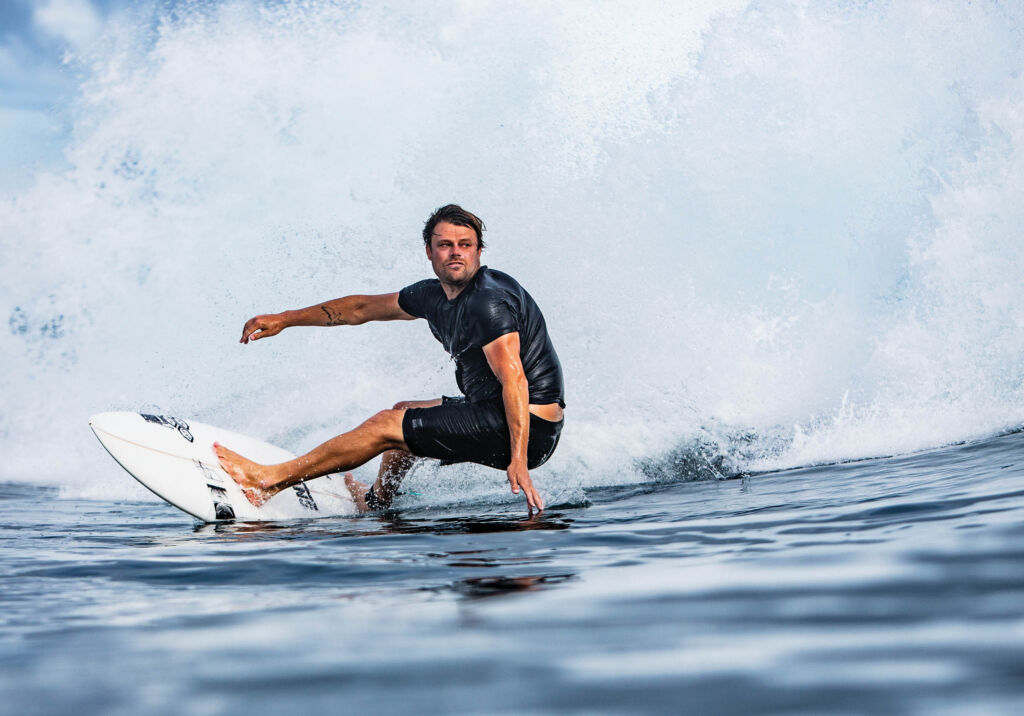
Sure, you can take measure of Dane Reynolds in the films, the clips, the merch, the soundtracks, the contests, the contracts, the zines, the drawings, the clothes. But, at its core, what keeps us tuned in is pretty straightforward. Photo by Nate Lawrence.
“Honestly? I just find humor in my everyday life. I feel like I’m often caught in a Curb Your Enthusiasm episode, and my inspiration these days is turning the irony of everyday occurrences into a story. I don’t even know if I’m using ‘ironic’ in the right way, because I heard that Alanis Morissette song completely uses it in the wrong way. But anyway, there’s so many good surfers in the world that—who cares? It’s all about storytelling and character building—whether that’s riding a different board or getting skunked or whatever.”
“What do you like to see in terms of surf style?”
“There’s no criteria. Sometimes you see surfers who aren’t even that great but are just doing a cool thing. Gabriel Medina is obviously far and above more technically advanced than, like, a Dave Rastovich, but watching that Dave Rastovich Electric Acid [Surfboard] Test [with Stab] tunes me in. It’s just not a sport.”
“But if you had to break good style down into a set of techniques, what would they be?”
“That’s like asking what makes good art. It’s authenticity, and it can take many forms. In general, it’s to mix technical difficulty with a certain attitude. You don’t want to look like you’re trying too hard or too polished. But if you start thinking about that, you’ve already blown it. But you also can’t try to not try too hard.”
“And you can’t try to not try to not try too hard?”
“You’ve just gotta be yourself. Like, Eithan’s style has some qualities that are bad, but his attitude makes it okay. He comes out of a turn just like ARGHHH, with so much attitude, and that makes it work. Eithan’s genuine skinny meat head comes out on a wave. But it’s weird to talk about style anyway because it’s like… Whatever. Just shred a wave. But if you’re paying someone to film it, you might as well be doing it at a certain level.”
“Speaking of which, you’re not 25 anymore,” I said. “Are you starting to feel your performance slipping?”
“Oh yeah,” Dane said and laughed, like, duh. “It’s gone. My bag of tricks has a big hole in it.”
“You do fewer airs now?”
“Not on purpose! I’m just not able to surf as much as I used to. I can’t believe how lucky I was to be able to wake up every single morning and just surf all day, every day, and see a swell and just be like, ‘I’m going there,’ like, all the time. And I didn’t feel as fortunate as I should have at the time.”
“How do you adapt?”
“With age, you want to play to your strengths. I have no interest in trying to keep up with the kinds of airs kids are doing and stuff, but I still feel like I can do a good cutback.”
“I guess an alternate approach,” I said, “would be the Kelly Slater ‘try to live forever and just never let it go.’ Do you have a competitive comeback in your future?”
“I almost did, and then I didn’t,” Dane said and cackled. “I talked to my friends about it. Virs was psyched—he was gonna be my trainer. But then we didn’t. Maybe someday.”
“How do you see your surfing changing into your forties, fifties, sixties, and beyond?”
“Keep declining.” He laughed again. “Honestly? I don’t get that much joy out of just standing on a surfboard. I like to move. I like the feeling of being on rail and projecting out of turns.”
“Do you think your style is a way to vent some kind of rage inside of you?”
He considered it.
“Not consciously,” he said. “But maybe.”
“What kinds of things make you angry?”
“The lack of waves,” he said and laughed, but I could tell he meant it.
“You’ve been pretty wave starved?”
“For sure. I haven’t scored since two years ago in Sumatra. I just have way less time. I pretty much just base my life around my kids.”
“That’s a choice you make,” I pointed out. “You could just say, ‘Fuck them kids—I’m chasing swell.’”
“Some people do, and I personally don’t really respect that. I just feel like if you’re gonna bring a kid into the world, it’s your duty to raise it. A lot of pro surfers just bail situations like that.”
He seemed reluctant to elaborate, like he didn’t want to shit-talk.
“Did your upbringing inspire that?”
“No. It just doesn’t feel like a choice, really. We decided to have kids. One conscious decision is—my worst nightmare is having a 30-year-old child. You want them to be solid people. Maybe a little part of it is I saw how much trouble my brother caused my parents, and I want solid kids who are good people.”
“In contrast to the theme of dutiful parenthood, you used to be beloved for your more rebellious persona. I’ve listened to recent interviews where you’ve called that version of yourself ‘an asshole.’ What changed?”
“Starting my own business. You just suddenly are like, ‘Fuck, this is what I was shitting on?’ All these people are putting all this work into supporting and presenting you, and I was just arrogant. I didn’t understand business. I took it for granted. Such a lucky thing to be able to get paid to surf, but when I was making a lot of money from surfing, all I saw was the pressure—not all I saw, but it felt like a burden somehow. Then, when I saw what it takes to create something that can survive—I was just an idiot. I was blind. I couldn’t see how special and lucky it was at the time.”
“But didn’t you find Quiksilver stuff corny and fake?”
“Quiksilver now or Quiksilver early 2000s? Because Quiksilver early 2000s was sick.”
“When did you see it going wonky?”
“I probably don’t have an accurate memory of that, but even when it was sick, I was like—and I learned this from other pros, too, that it’s like, ‘Oh, you want me to wear these trunks for a photo shoot? These things are wack, dude.’ You know what I mean? I learned that from other people, to kind of be like, ‘Fuck those guys! They’re wack!’ even though they’re paying you to surf.”
“But people loved that about you.”
Photo by John Respondek.
“I know, but it still wasn’t cool. When I was making a lot of money off of surfing, I also didn’t have kids and the type of overhead that I have now, and now I’m seeing money come in and out and I’m like, ‘Whoa, geez.’ Everything costs so much, and now I’m barely making enough off surfing to maintain, and dipping into savings is pretty humbling.”
“Are you banking on Former and/or Chapter 11 to succeed? Like, are you in a tough spot financially?”
“No, I’d be fine if Former didn’t eventually give me a huge payday or something. I’m fine. But it’d be nice. With the amount of time and effort I’ve put in, it would hurt pretty bad if it never paid off.”
“Like, your ego?”
“Yeah. But I don’t know where the value lies, because Former has grown very rapidly over the last couple of years, but in turn there’s no money to put back into the brand. It’s just, like, blanketing the world in clothes. And I’m like, ‘You guys wanna do a film? Let’s go on a surf trip!’ and they’re like, ‘No money.’ I don’t want to paint this in a negative light, but I’ve been a little frustrated the past month about it, because I just want to put money into building the brand, and we’ve been growing so rapidly [that] there’s not much money to invest back into the brand identity.”
“In an alternate universe where you never move to Ventura, you stay in Bakersfield and keep skating—are you on Thrasher covers instead?”
“No way. No. I’m not… Uh, no. I’m too scared.”
“It’s nice to fall in water.”
“It’s nice to fall in water, but I don’t like big waves, either. I’m not an extreme person. I like medium-sized waves. When flotation devices get involved, I’m over it.”
“What would you be doing with your life if you never got into surfing?”
“I don’t know. Honestly? Probably working for my dad’s HVAC company.”
“What do you want to be known for now?”
“Uhh… I don’t know… I don’t know. I don’t really care. I don’t know.”
“How’s your anxiety these days?”
“Not great.”
“Do you think you’ll ever stop surfing?”
He paused.
“Eh…” His voice inflected upward again. “I don’t think so.”
“Where do you want to go with your surf films from here?”
“I’d like to get into aspects of storytelling outside of surf. Filmmaking is maybe my ultimate goal. I’ve actually been thinking for a long time about writing a sitcom.”
“Like Curb from the perspective of a pro surfer?”
“Yeah, but not even from a surf perspective. Just the absurdity and irony of my everyday life.”
We spoke for nearly four hours. Dane recounted how he’d had some creative clashes with Austyn and Craig, whose more goth, fashion-forward aesthetics didn’t fit with his naive art. In fact, he had originally wanted to name Former “Chapter 11,” but his co-founders weren’t on board. Chapter 11 was his name.
We also discussed Sammy’s surf potential (history repeated itself when, like Tom with him, Dane failed to get Sammy into it), the “ego-crushing” nature of Pipe (where, in 2017, Dane fell coming out of a tube at Backdoor and sustained a hairline fracture on his T12 vertebra), what a panic attack feels like (“Like there’s a lion in the room—this intense fear, but from nothing”), and Dane’s cinematic influences (his favorite documentary is Werner Herzog’s The Great Ecstasy of Woodcarver Steiner, which, uncannily, is about a prolifically talented ski jumper trying to cope with the psychological pressures of competition).
Our conversation went by in a flash. Suddenly, it was time to close up shop. As we were wrapping up, Dane chastised Martinez: “Don’t be late tomorrow,” he said. “You’re always late, and I have to leave in time to take Sammy to Scouts.”
Dane had custom-embroidered Sammy’s Boy Scout uniforms, and he’d be delivering them for a big troop meeting the next morning.
•
A couple days after the Skinny Meat Head premiere, the Chapter 11 crew packed into Dane’s black RAM 4×4 (basically an armored tank for ferrying kids) and took the film on the road to Proof Lab surf shop, a Bay Area institution just across the bridge from San Francisco, where I happened to be staying with my girlfriend.
To promote the screening, Proof Lab organized a surfabout with Dane and the boys at Fort Cronkhite/Rodeo Beach, a marginal, crescent-shaped beachbreak backdropped by a WWII mobilization post, a cluster of red-roofed barracks and mess halls set against the rolling green hills of Marin.
“Dane! Is surfing Cron!” Proof Lab had posted to their Instagram account, accompanied by a shot of a fan posing with Dane, who was forcing a smile and a half thumbs-up.
A publicized surf session: It seemed like his personal nightmare. But he was a good sport about it.
The session was scheduled for late afternoon. All morning, the rain had come down. The scene at Cron was dreary, the sky like gray marble swirling overhead. The surf was junk—cold, 2 foot, borderline closeouts. You’d have to hope you lucked into a corner.
By 3 p.m. on a random Tuesday, the parking lot was full, with overflow vehicles stacked along the side of the road. Packs of hooded teenagers whispered excitedly and glanced about.
I found Dane by his truck in the lot, already suited up, black wetsuit, hoodless and bootless, waxing up a black, stubby hunting knife of a board.
Photo by William Sharp.
“You gonna surf?” he asked.
“Probably not,” I said.
“Why not?” he asked with total earnestness.
Gee, I don’t know, I thought to myself. Maybe I don’t want to embarrass myself groveling in front of one of the greatest surfers of all time?
“I should watch for a little bit, then maybe I’ll go out,” I lied.
He shrugged and made his way across the street and down the wooden staircase to the beach. I followed a bit behind. The sand was wet from the rain and strewn with bits of driftwood from that fall’s heavy swells.
Cron is mostly shorebreak, but the northern corner can accumulate sand and create a semi-consistent right. Already there were 20 guys on it. Both air and water hung in the low fifties, their chill preserved by the overcast sky. Almost everyone else was wearing a hood. Dane walked to the water’s edge, held his board across his chest like a barbell, performed a single squat, and waded out.
Osborne was already in the water, doing laps and hoarding waves. He stood up going frontside on a right, swooped a nice high line, double-pumped, wound up, and spun a quick air reverse off an end section. On his next wave, he negotiated a clean frontside snap off the top. He was light (5’8″, 150 pounds in a sopping wetsuit), compact, and 24 years old—perfectly suited to make the most of the piddling conditions.
Dane was easy to spot—the biggest figure in the water, with his iconic bowl-shaped mop of hair. He floated somewhere in the middle of the pack, letting the more aggressive surfers fight for the sets out the back. He went to paddle for one but couldn’t quite get into it, and it rolled under him into the shore. The next one was a little inside right. He was a half-second slow on his pop-up but still managed to dance down the line and hit the end section for an air reverse attempt—but the board went too vertical and went bouncing away in the whitewash.
As the session progressed, the crowd grew until Dane was surrounded, by my count, by nearly 50 other surfers, many of whom, given the conditions and random weekday timing, were undoubtedly there for him. Suddenly, he picked off a small, crumbly right on the inside, maybe chest-high at the peak but with a good angle that offered an open line. A guy hassling down the shoulder pulled back and snowballed the section in front of him, but Dane anticipated this. He rebounded off the crumbling section, a little top turn that popped a burst of spray.
What happened next was at once unimaginable and so subtle you could have easily missed it. Crouched low in attack mode, Dane used the momentum of the bounce off the snowball to swoop out in front of the face and bury half his board into the flats, bottom turning, his body horizontal, a huge jet of spray blasting out behind him. Then, just as quickly, he swiveled back up the face and whipped a vertical forehand snap, two-thirds of the length of his board protruding above the lip.
The clip wouldn’t make a Chapter 11 B-side, but that wasn’t the point. The point was that it should have been physically impossible for a 6’1″, 200-ish-pound man to perform such an angular and powerful maneuver in such feeble surf. He’d squeezed out every drop of juice.
“There’s something about his surfing that’s raw and unexpected,” John John Florence said to me when I contacted him about Dane. “His airs are powerful, if that makes sense. He pushes all the way through his turns. He’s not cutting turns in half. It’s all out on every turn, using the full wave and carrying so much speed.”
For all the anxiety about John John supplanting Dane as the world’s unofficial favorite freesurfer, it’s Dane who remains John John’s greatest influence. “He’s my favorite surfer,” he said.
“Great athletes are profundity in motion,” wrote David Foster Wallace in trying to explain what makes performers like Dane so compelling. “They enable abstractions like power and grace and control to become not only incarnate but televisable. To be a top athlete, performing, is to be that exquisite hybrid of animal and angel that we average unbeautiful watchers have such a hard time seeing in ourselves.”
Of course, their demigod intrigue comes at the cost of privacy.
“So we want to know them,” Wallace wrote, “these gifted, driven physical achievers. We too, as audience, are driven: watching the performance is not enough. We want to get intimate with all that profundity. We want inside them; we want the Story.”
Social psychologists call this the halo effect—the cognitive bias whereby someone becomes famous for one thing, so for some reason we care what they think about everything. If we can just figure out what makes them tick, the logic seems to go, we might be able to replicate that formula, and so rub a little of their stardust off onto us. But when we look up close, what we find, apart from the gift, is the standard mess of paradoxes that makes a human being.
Dane is highly sensitive to the expectations he carries by dint of his gift, as well as the uncomfortable hypocrisy of his success. His caginess is not just an affectation, or him thinking he’s too cool, or a constructed persona to generate mystique. If anything, it’s a symptom of the perfectionist’s trap of caring too much.
I think I’d give anything to surf like Dane Reynolds, but then, I’m not considering the attendant burdens of talent and fame, the inextricable flip side of the coin. “There’s still a lot of pressure,” he assured me.
A profoundly talented surfer and surf filmmaker, his easy intelligence, keen aesthetic taste, and tireless obsession have made him a kind of creative avatar for hardcore high-performance California surfing. Time, experience, and the cost of raising three kids have matured his naive idealism into an appreciation for business as a kind of third art that affords him a vehicle to continue to share his vision in the surf and on the screen—it just has to be his idea.
He’s making things on his terms, in alignment with his vision of what surfing is—an absurd, debauched, occasionally sublime way to rip through life with your fellow misfits.
His progression—from Quik to Marine Layer to Former and now Chapter 11—can perhaps be understood as a kind of Russian nesting doll in his eternal quest for creative control. Perhaps his fifth big act will be that Larry David–style sitcom he’s secretly dreamed of writing. (I imagine the protagonist as an ex-pro surfer who just wants to write a sitcom about everyday life, but everyone keeps pressuring him to surf instead.)
“Dane is a much more free-minded person than a competitor needs to be,” Kelly Slater wrote me. “But his video parts and performances are the thing of legend in the surf world.”
Of course he was right. Competitive surfing doesn’t measure sheer talent alone. It measures the willingness of sheer talent to conform to a schedule, a heat, a certain set of criteria. Dane was never motivated by those things.
He was driven by speed, edge, and air, a desire that leads to the inevitable tragedy of any surfer at the peak of their skills, or anyone whose life’s main purpose is tied to what their body is capable of.
In their thirties, an age at which the average adult’s career is just taking off, the top high-performance surfer’s skills have already begun, if imperceptibly, to decline. Wallace described the athlete’s early life fall-off as being “just like death except you have to go on living afterward.”
“Is Dane masking a deeper sadness?” a friend asked when I told him about this piece. I considered it. On the surface, it seems like there are things he could be doing to surf more, to take better care of himself (he has never trained, or seriously rehabbed injuries), to fill the “hole” in his “bag of tricks,” as he put it, and perhaps feel better about the shit waves he’s stuck with, the lion that stalks him, and the demands that eat at his mind. But there is something refreshingly real, in an era of borderline psychotic health optimization in professional sports, with countless aging athletes death-gripping their careers, about a god-tier talent refusing to deny himself the everyman joy of post-surf parking-lot beers with the boys, and happily extending his platform to the next generation.
I found a clue to my friend’s question in an overlooked interview on the L8night With Choccy podcast, recorded over the din of a crowd at the 2024 Surf Expo in Orlando: “Honestly, my brother actually plays an odd part in this,” Dane suddenly offered of his discomfort with competition. “Like, if I was to really pick it apart, because he was always struggling with different things, his life was never put together, and I had this weird guilt, like I couldn’t embrace my success, if that makes any sense.”
Coming up in Ventura laid the groundwork for this guilt complex: “They wanted to tear you down, and you’re the guy that’s exploiting their spots,” he said. “And ‘fuck that guy filming.’ That’s what I grew up into, so you don’t want to flaunt. Park in a weird spot, paddle in a weird spot, and your filmer hides out.”
Who are any of us, if not amalgamations of our formative experiences—our families, our homes, our heartaches, the values these things have carved into our innards, to which the rest of our lives have been one continuous domino chain reaction?
Dane is, partially, just what happens when alien talent meets passionate obsession, old-school localism, challenging family circumstances, and an innately sensitive nervous system. But that’s reductive. Siblings grow up in the same homes, with near-identical experiences, and emerge as wholly different people. Whatever it is that accounts for that difference—that is what is only us. Dane is a self-aware iconoclast, a satirist with a hyena’s chuckle, a family man in a real-life comedy, a painter on a riding surface, a surf junkie in withdrawal, and, yes, a businessman.
You know that old saying about how if you’re not a liberal when you’re young, you have no heart, but if you’re not a conservative when you get older, you have no brain? That’s what Dane’s entrepreneurial era makes me think of. Is it a form of selling out, this new stance of earnest embrace toward business? I don’t know. Crucially, though, he’s making things on his terms, in alignment with his vision of what surfing is—an absurd, debauched, occasionally sublime way to rip through life with your fellow misfits.
And I’d argue there’s something even more authentic about the rock star who allows himself to grow up versus the one who bogusly clings to the performance of youthful rebellion, even as a well-to-do adult with a house and kids.
Still, there remains a baffling complexity. “How can a man know himself?” wrote the philosopher Friedrich Nietzsche. “He is a thing dark and veiled; and if the hare has seven skins, man can slough off seventy times seven and still not be able to say: ‘that is what you are; there is no longer outer shell.’”
Maybe the best way to truly see Dane isn’t to ask him questions about his life or what it means, to have him package the immense, swirling complexity of everything a human consciousness holds into plain-language quotes, like asking an artist to explain the meaning of their art. Maybe instead we should pay attention to everything he’s been communicating all along.
“What the really great artists do,” Wallace said, “is they’re entirely themselves. They’ve got their own vision, their own way of fracturing reality, and then if it’s authentic and true, you will feel it in your nerve endings.”
The closest thing to a direct statement of his identity that Dane may ever give us might be this prose nugget from his “Declaration of Independence,” from way back in 2011:
i always think about how lucky we are that there’s even an ocean, and its not too hot or too turbulent and it’s not made of acid that burns our skin off. and how lucky is it that the land tapers into the ocean in just the right way so that when lumps of energy approach from a thousand miles away they gently rise up and crash at just the perfect speed so that we can wave our little arms and match their speed and hang at the crest weightless for just a second before sliding
down the face. free to ride it in any way you please. and there’s not just one of them. there’s tons of them. they keep coming. all different sizes shapes and speeds. everyday they’re different. endless joy.
Or, if brevity’s your thing, there’s also this little two-liner of a poem he wrote as the epigraph for 2013’s Slow Dance:
If there is a heaven I know where it be, Under the folds of the hills that roll through the sea.
Pull up a clip of Dane on a green wall at Rincon, where other surfers will do some version of a bottom-to-top-to-cutback combo, repeating it all the way in. Then there’s Dane: fluttering high line, sudden plunging down-carve, snappy kick-stall into a tube that seems to form less from bathymetry than from his own psychic will. Aw, shucks, you think, he didn’t make it—but you’re wrong. Here he comes flying out from under the curtain, swooping off the bottom like a bird of prey, dragging his hand, and smashing a cataclysmic power hack. But somehow he takes it a step further. He puts it into a spin that defies Newtonian mechanics, flipping on multiple axes at once, body and board lost in a hemorrhage of whitewater—then rides out clean. All you can do is laugh. You can’t believe it—but of course you can. It’s Dane. And the wave just keeps bending past as he disappears behind the back, rolling on down the point, punctuated by sporadic bursts of fin and spray like notes of jazz until you’ve lost track.
[Feature image by John Respondek]
Premium Membership
From $179.00
Become a premium member of reader-supported, independent journalism. Our premium members advance the work of The Surfer’s Journal. Enrollment at this level includes:
Bi-monthly delivery of The Surfer’s Journal
Custom Annual Gift
Listed as a TSJ premium member on surfersjournal.com
25% off merchandise and apparel in the TSJ store
Unlimited access to every article we’ve ever published