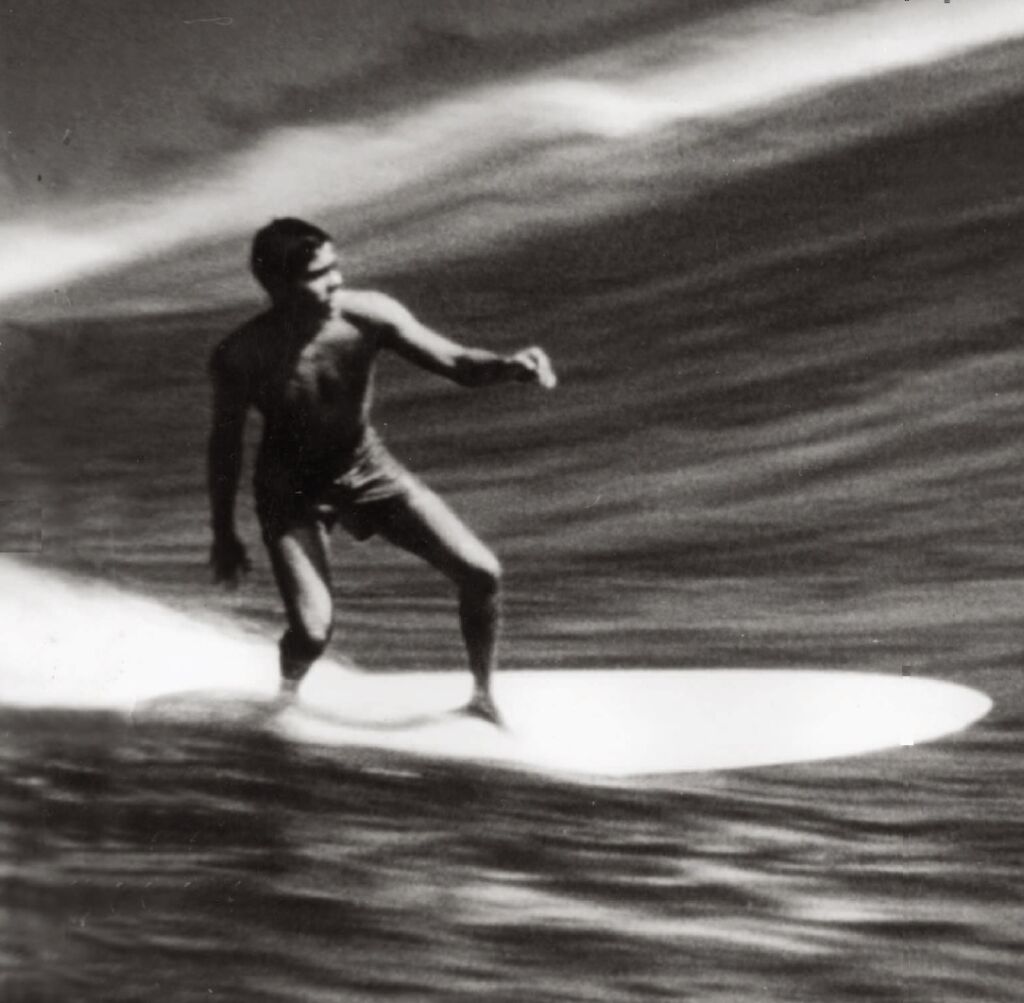
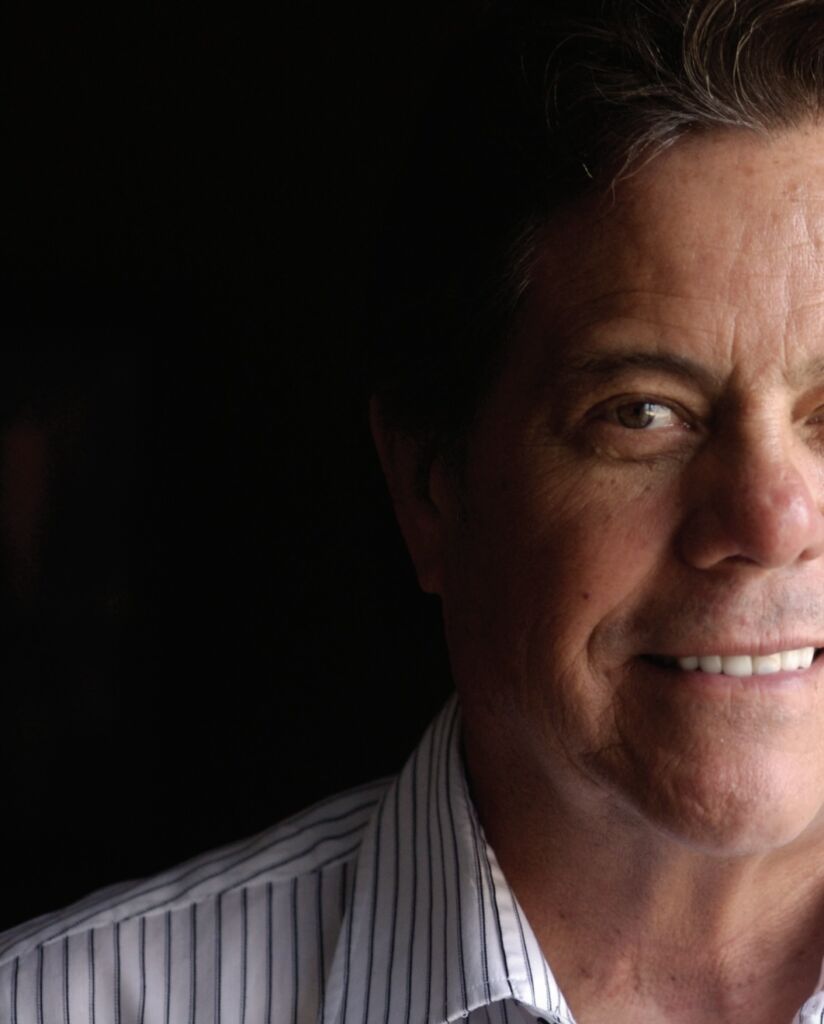
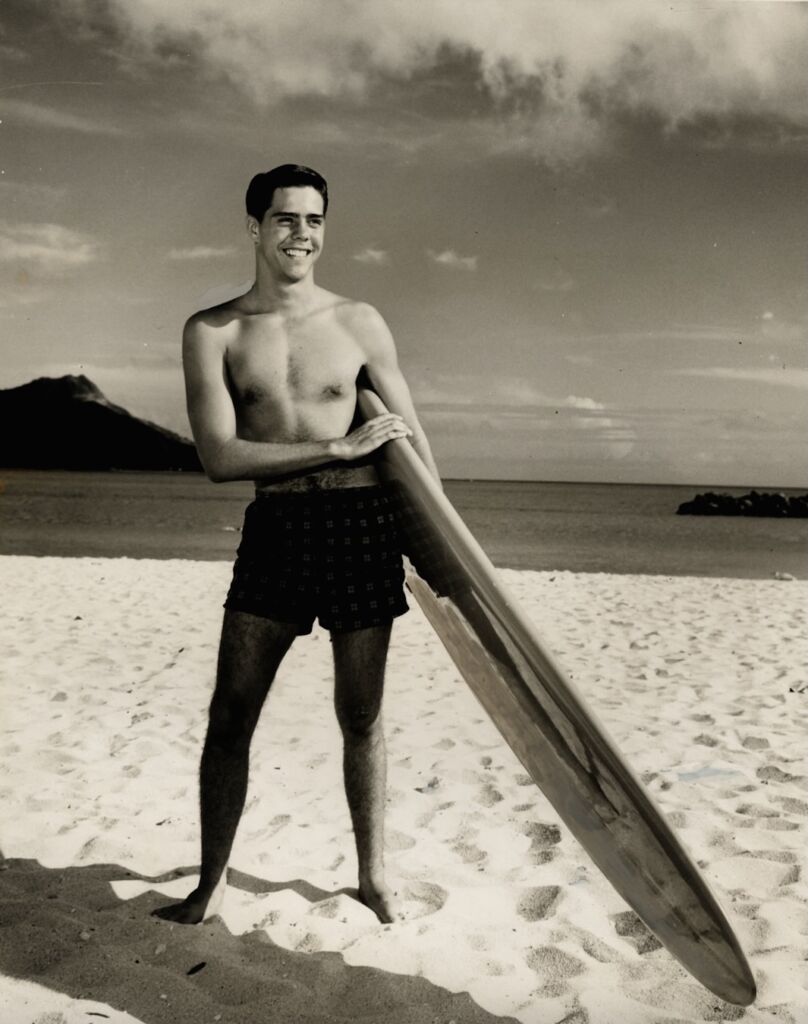
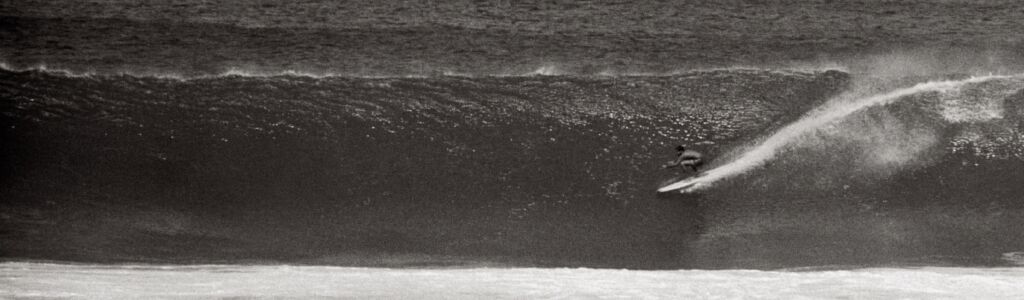
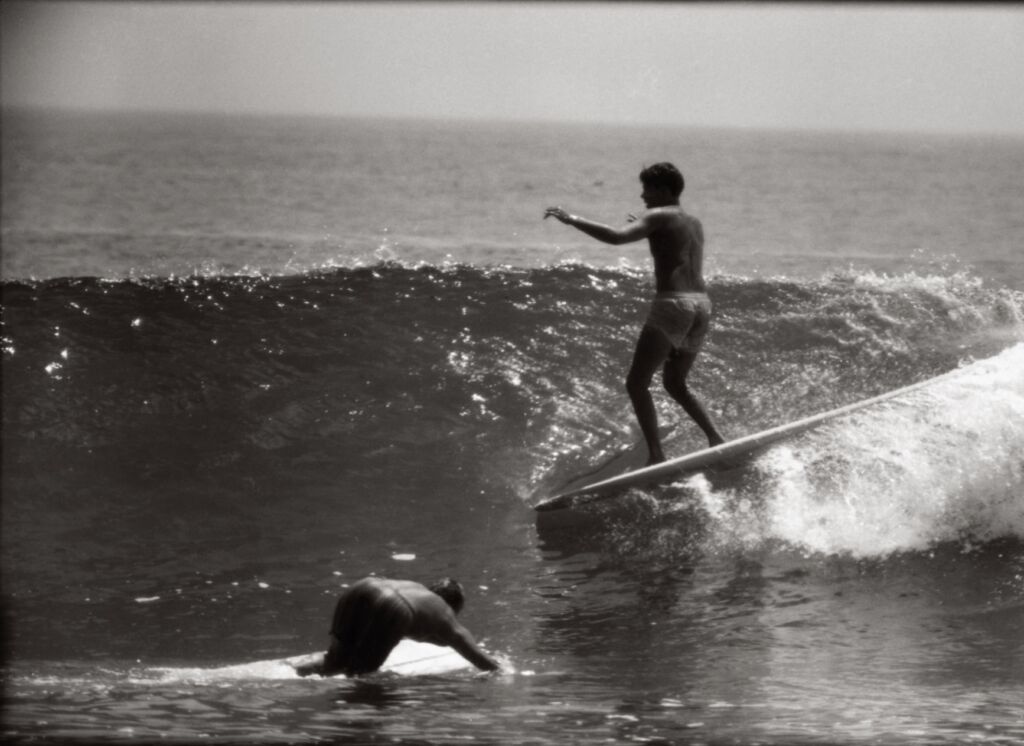
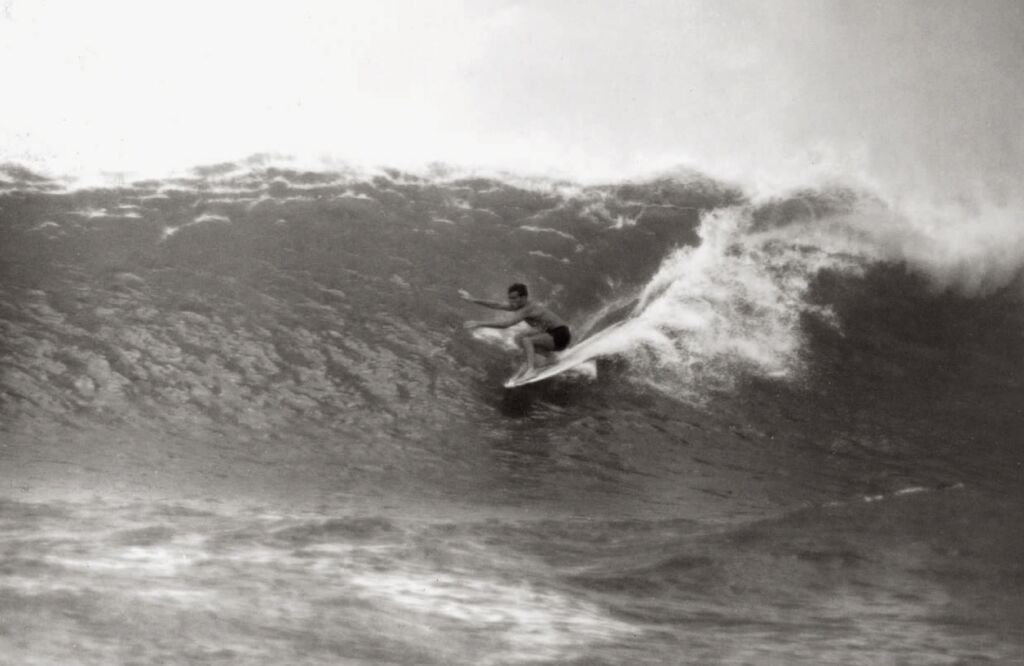
Gifted but mild-mannered individuals who don’t seek the spotlight—existing softly amid those who loudly call for recognition—are too often overlooked. This could be said of Paul Strauch Jr., a truly remarkable surfer for over four decades who quietly exudes the qualities of Hawaiian aesthetics and humble leadership that puts our sport and culture in its best light. As a Hawaiian surfer, with all that connotes, Strauch has been a hugely respected figure among knowledgeable aficionados and his greatest surfing peers for all those years—a form of recognition undoubtedly more satisfying to him than a constant flow of high-profile surf media acclaim. His celebrity was not always that subtle. In his younger years he was a household name ranking in the elite of our sport. Achievement-wise, he is the only surfer to have originated a functional surfing pose so distinctive that it was named after him: the “Strauch” or “stretch-five,” squatting with lead foot extended to the nose, weight over the back foot pressuring the inside edge, arms outstretched, allowing stable, forward-driving edge control on all sizes of waves. Though not competition oriented, Paul has done his share to represent Hawaii on the international stage (winning the Makaha International Juniors in ’59, the Peru International in ’63, and Makaha Men’s in ’69, and also reaching the finals of the Duke and World championships multiple times) while showcasing his smooth, ultra-luxe, power surfing approach. These days, while running a franchising business and serving as president and spokesman of the Hawaiian Surf Club at San Onofre, Paul lends his attractive aura to a California scene overly engrossed in the industrial age of surfing. In contrast, Paul points us to a different version of surfing wealth—one that is personal and spiritual.
SP Describe your surfer self.
PSJ Sure. Born and raised in Hawaii, I started surfing at four (in 1946) primarily because I had a chest defect, and health wise my father, also a surfer, wanted to build my appetite and get me exercising. So he took me down to Waikiki where he grew up and introduced me to the ocean. What child, handicapped or not, wouldn’t love to be escorted to the beach as often as possible and be caressed by the ocean?
SP You were encouraged to go to the beach by your parents rather than their objecting to your hanging out there, as many might.
PSJ Well, yeah…it got tense during high school (laughing). You know, that speech at dinnertime rings loud and clear to me… “Those waves were here before me and they’ll be here long after we are both gone. Now you focus on school.” At first it was playtime in the ocean, being pushed into waves. I’d fall off. You know, you can’t turn a redwood plank, but you just keep trying and gradually start to control it a little bit more.
SP Major transitions happened while you were a young surfer. Were you aware of them?
PSJ Oh, yeah. I was fortunate at the time because Hawaii was a small community. Everybody eventually comes to Waikiki and you meet all the mentors. There’s a hierarchy in Hawaii; it used to be a feudal system and the chiefs ruled. But in surfing at Waikiki it was the elders, mostly the beach boys. You learned very early that there was a no tolerance rule. If they’re on the wave, you let them go by, and then you kind of fill in behind them, ride their wake. If they’re around, you respect them. If they notice that you’re respectful, they gravitate to you.
SP Who had a hand in your nourishing?
PSJ Duke was older and I didn’t see him that often, but he was in the front guard. I was a member of the Waikiki Surf Club. My father helped them obtain property to use for the club right on Waikiki Beach from Rudy Tongg (a friend of my dad’s) where the old Steiner estate used to be, right next to the Waikiki Sands restaurant, which was owned by Rudy. I went to school (Punahou) with Rudy’s sons, Michael and Ronnie. They lived at the end of Kalakaua Ave. at the base of Diamond Head, and the surf in front of their family compound was named Tonggs after their family. My older sister, Muriel, married into the Thurston family that lived next door, and I spent hours learning every surf break in the neighborhood. Everything connected for me right there.
Back to the question, I’ve always had respect for guys like Blackout Whaley, Richard Kauo, Rabbit Kekai, George [Downing], and Wally [Froiseth]. Many other talented surfers like Dingo are not here anymore, but those special ones really stood out from the rest of the crowd. Each one of them mentored me in the ocean, including my father. Whenever I went to the beach, the beach boys were there out in the water surfing or teaching. After a while, you became recognized for being polite and quiet. If you were boisterous and obnoxious, you were dealt with in that way, and you learned quickly that way is too painful to go through. It’s much easier to say, “Yes, Mommy. Yes, Daddy,” do the work, and then you’re free. Instead of resisting, and be forced to sit through all the sermons and everything [chuckle]. I found it’s much better to follow tradition. This way they bring you in, and as a result give you certain instructions and help. When this happens and because of that association, other people observe this. They see their peer group accepting you, and all of a sudden you’re maybe not “chosen,” but above the rank and file and that really paid off. It goes around full circle, especially when you’re older. Those people that helped, a lot of them are gone, but along the course of your surfing life you end up helping others as well, and eventually you become the mentor.
SP What portion of Waikiki was your zone?
PSJ Queens was the epicenter of Waikiki surf. It still is. A few years ago I showed Rabbit something at the Duke Ocean Fest. I was sitting on the beach waiting to get my jersey and saw Rabbit walk by. I looked out at Queens and thought, my God, there he is! I remembered him from a very early age, and he’s still surfing here! So, I started figuring out beginning from when he must have started, how many waves per day, 365 days a year, he must have surfed. Thinking you can’t ride every day, I took a percentage, like a third and bumped it up to about 40 percent, ’cause he’s gotta spend time to make a living teaching surfing and steering a canoe with tourists. I ran the numbers out and figured that, conservatively speaking, he must have caught over a million waves in his lifetime at Queens. I rechecked my numbers with a calculator and they proved out. When I saw him walking by me again going the other way, I stopped him and said, “Rabbit, come over here, I want to talk to you a second.” I explained I had just gone through this serious calculation and I wanted to share it. “You know, you’re one of my heroes. I’ve told you this many times before, but I’m serious about this, Rabbit. If I can in my lifetime, I’m going to have a special plaque erected on the beach facing Queens, and it’s going to be about you, because I don’t think anybody has caught more waves at Queens than you have.” And he says, “Wow, that’s really nice.” So, I show him my math, take the time to explain everything all the way down a full page of longhand computations, and I tell him that down here (pointing to the bottom line) this is the important number. “I believe in your lifetime, you’ve ridden over one million waves at Queens!” And he looks up at me and says, “I think it was more, Paul!” After about five minutes, I stopped laughing and told him, “I love you, Rabbit!”
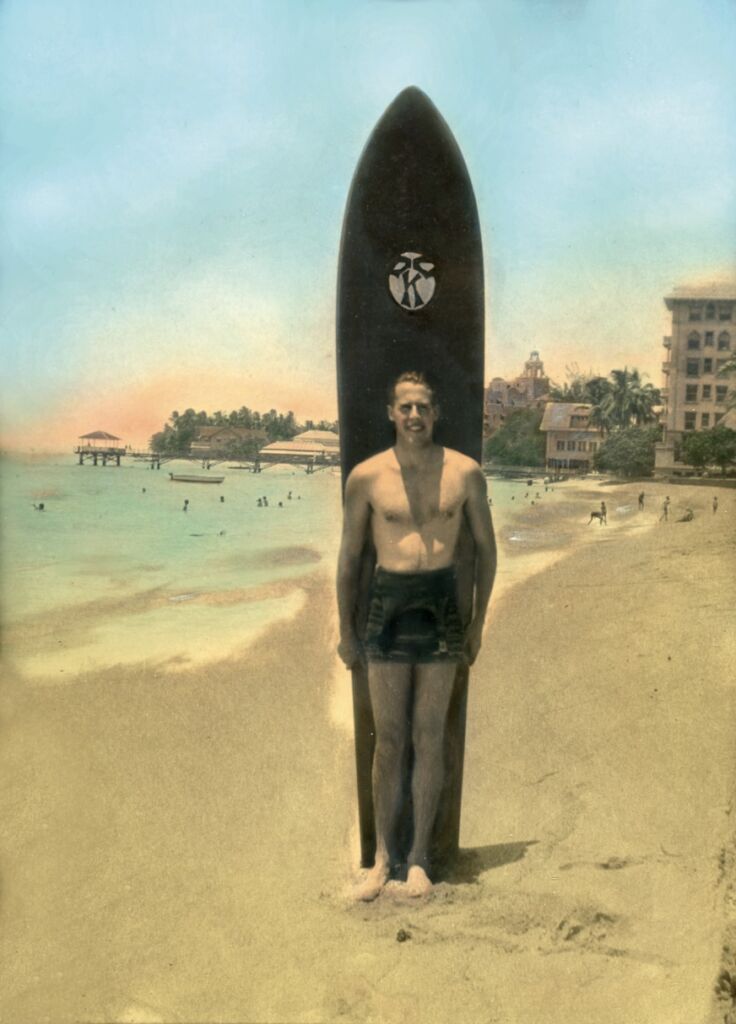
SP A few like Richard Kauo, Squirrely Carvalho: I hold a distinct image of them riding hot curls in a rakish style that was perhaps the seed of modern surfing.
PSJ They both surfed boards with pulled-in tails and thin rails aft, which allowed them to maneuver and turn faster. You could direct the board easier in certain parts of the wave—no bottom turns because they didn’t have pronounced skegs, but you could angle easier and roll the board into a turn a little bit more. As a result, all those guys surfed the tail. They didn’t move up much. Trimming was everything then. The narrowness allowed them to stand back and redirect. The noses were wide in the early ’50s, but then they started really pulling them in to reduce the catchy front edges. This is different from where it went in California, for good purpose, though. It was a functional evolution more than about aesthetics. Hawaii’s surf was bigger than California and you needed more control. Personally, I was very lucky because of my dad’s background in surfing. He knew a lot of people, and, in turn, I was able to meet a lot of different great surfers and special people like Able Gomes, a finish carpenter and father of Allan Gomes, a contemporary of mine. (Able was known as one of the finest board builders in the ’40s and into the ’50s, Allan, one of the hottest early ’50s Waikiki surfers who moved to California and opened “Glassed by Gomes.” One of his triangle decals under the Velzy & Jacobs oval indicated boards coming out of Velzy’s San Clemente shop.) Through my grandfather, my father actually brought balsa wood in from Ecuador and had a surfboard fashioned from it. He used dowels to hold the planks together and it was Spar varnished. My father put small dings in the deck from his toenails and buttons on his shorts, so he had Able put a veneer of mahogany on the deck. It had a round boat bottom, and it was wide much like Duke’s boards. I have photos that show its outline shape.
SP What time frame is this happening in?
PSJ My father graduated from high school in 1927, and he had the board before that. It was a wide-tailed, all-balsa plank that he kept sitting upside down on sawhorses in our garage. In the early ’50s he added a skeg, which he said gave the board much more control. I started out on a redwood plank, which was my father’s. Then he bought me an eight-foot hollow board from McWayne’s Marine Supply in Kewalo Basin near Ala Moana. Both boards were without skegs. The hollow board was interesting. It had square edges so I could turn it faster because it would bite on a turn and change direction quickly. The plank (with rounded bottom “kettle” rails) would roll over gradually into a turn. However, you couldn’t keep the hollow in the wave once the wave broke. As long as you were out ahead of the whitewater you’d be fine. As soon as the whitewater hit, you had to straighten out real quick or lose control. When I was 12, my father had Tom Blake build us both balsa boards. Tom came to our home in Makiki. He rode his bike sometimes or caught the trolley and walked up the hill. We all went down together and bought the wood at McWayne’s and brought it home. He did the whole deal, cutting and gluing the wood and adding some balsa to the top of the nose on both boards to create a spoon-like lift on the bows. I watched as much as I could, peering out from the back door most of the time so as not to get in his way while he used a cross-cut handsaw for the outline shape, an adze to rough cut the edges, and then a hand plane to fine shape. It was a long process. He did both boards side-by-side. My dad’s was 10’6″ and mine was 8’6″. Tom wasn’t very talkative, a very quiet man, but being inquisitive I’d ask him questions and he’d explain everything to me. He ended up putting a swallow tail shape on my board. I asked him why he wasn’t cutting it straight across like my father’s board? He said, “Well, it’s going to allow you to turn much faster.” and I asked, “Why?” “When you have a narrow tail and step on the back it sinks in quick. By having these two points on the back end, if you step on it and then lean on one side, it’s going to sink that side quickly. That will allow you to turn the board much easier because it’s too big for you now.” It was a total learning experience for me. I watched the whole process: shaping, glassing, and everything. When he completed the fiberglassing, he had this little two-sided fin mold that he had made, shaped so that when the fin came out it was completely finished. I said, “Wow, that looks like an airplane tail.” He said, “That’s exactly what it was, a B-52 tail.” He told me when I turned it would go in that direction and that I would be able to move up to increase speed without the back end coming out. He asked if the smaller of the two hollow boards lying nearby was mine and if I had the problem moving forward and maintaining control. We’d get into these conversations on design theory and engineering rationale. I ended up using the new board, and all the tips he shared with me provided a real breakthrough for my surfing. My Blake board was lighter, easier to paddle and turn, and just a dream to surf. It changed everything for me.
I learned from Blake that having the right equipment plays such a major difference in performance. Sure, you have to have natural talent, coordination, timing, and good judgment, and work diligently at improving everything, but an equally important aspect is having the best equipment.
SP Who have been some of your primary board maker relationships?
PSJ I got my Blake board was when I was 13. I also had a couple of boards after the Blake. A special one was another balsa that Joe Quigg made me. At first, he kind of approached me (a soft, self-conscious laugh) and we talked about my surfing and board design. He made me a nine-foot balsa board, a lot more racy than the Blake with a narrow, pointed nose, square tail, mildly-domed deck, which blended beautifully into the rails, flat bottom, and thinner, too. It was beautiful. But I totaled that board. The first time I used it was at Haleiwa. I lost it and it went right into the rocks. It was horrible, one of the worst experiences I’ve ever had with equipment. I was so upset and disgusted at what happened that I threw my brand new Quigg into the bushes. I was just sick; I didn’t even want to look at it. The friend I was with pulled it out and took it back to Town for me. I eventually repaired all the dings, refinished it in a solid lime-green color, and ended up surfing it for quite a while longer. Joe is still one of surfing’s master shapers, a man I have always admired.
Bob Shepherd shaped my first big-wave board, another balsa, in 1957, when I was 14. He was living on the North Shore and had a shop in Town. Bob was much like Tom Blake, very quiet, kept to himself, and would respond to but rarely initiated conversation. He was really an excellent craftsman, though. God! What a beautiful board he made me. It was a pristine 10’4″ square tail, flat bottom with sharp rails in the tail. I rode Sunset for the first time on it and made every wave. It was so fast. Of course, it’s impossible to go slow at Sunset, but what a thrill it was compared to other North Shore surf spots.
SP I remember in 1962 I noticed both you and George riding Kaiser pink guns he had shaped at Sunset.
PSJ True. George Downing, besides my father, was my closest mentor and a very close friend. During my teen years, George shepherded me into riding the North Shore and big-wave surfing. He taught me to always first wait and observe the ocean and surface conditions especially in rising surf. To pay attention to things like wind direction, sets and wave intervals, rising or ebbing tide, the flow of ocean water coming to shore, and the direction of rip tides that transported high volumes of ocean water back out to sea. I remember sitting at Laniakea with him on many occasions, watching 10- to 12-foot surf, 15- to 20-foot surf, and 20- to 25-foot surf, and on each occasion he pointed out how the rip changed its movement due to the differing water volume and how to use it to get out and into the lineup, and more importantly, how to get back to shore when you lost your board. In big surf, you need to learn quickly that the safest route to shore is in the impact zone and then in the whitewater. It’s the most punishing and physically demoralizing place to be, but it is the quickest sure-fire way to shore. One time, Laniakea was 15- to 20-foot-plus, and closing out every 20 to 25 minutes on the outer reef with a rising swell. It was spooky, and I had my eye on the horizon constantly for closeouts. Carefully checking his landmarks to find the right lineup, George led me over to a narrow zone of calm water about three-fourths of a mile from shore where the outer reef set waves would back off, reform, and we could take off. Believe me, there wasn’t much room for error, especially paddling back out and finding this takeoff spot, otherwise, you’d lose your board and spend an hour or two trying to make it back to the beach.
There was also all the board design tutoring he shared with me: hydro-dynamic principles of curves and water flow in relationship to speed, deceleration, acceleration, weight displacement, floatation efficiency by the cubic volume ratio of board mass to a surfer’s body weight, outline shape, etc. One of his most ingenious board design paradigms was what he called his “calculated drag” theory. This process included the measurement and corresponding relationship of a list of factors including plan shape, the ratio between a board’s cubic volume and the rider’s weight for floatation, bottom curve, planing area, and rail design, to create both speed and calculated drag by shifting weight to quickly reduce speed and change direction, and then quickly increase speed again. Mind you, we’re talking about 10’6″ to 11′ big-wave boards in the late ’50s and early ’60s, which prior to this were usually surfed in one direction with very little turning. In retrospect, I think George should actually be recognized for his pioneering board designs that enabled the “cut back” in big surf. He is a true master craftsman and a living treasure of surf knowledge bar none.
SP Who makes your boards these days?
PSJ It’s not easy to find a shaper who understands hydrodynamics and design functionality, and who will listen…. With those who are older, sometimes you get to fully explain what you want and why. Mike Minchinton is like that for me. He has great knowledge and skill, and listens. I’m lucky to have found him.
SP In brief, how would you instruct a shaper? What are the basic characteristics of a board you’d like to ride?
PSJ Well [deep breath], recently I’ve been going back to a narrower board, narrow tail and narrow nose: a 15″ nose, 12-1/2″ pintail, 22″ wide with a tri-fin, because you can change the direction so much quicker. It’s very fast, and I use it in small and big surf. Nose riding is fun, but I think you can utilize much more of the wave with a faster board than with a nose rider on which you slow the board down by stalling on the nose. It’s just a personal thing for me now.
The most exciting time in my surfing was when I started to ride big waves on the North Shore. Waikiki can get big during south swells, but the North Shore is a whole other dimension. As a junior in high school, I bought a 10’10” redwood balsa pintail from a classmate at Punahou. I found out later it originally was Al Nelson’s personal board that he shaped and rode on the North Shore. It had an old, glassed-on, half-moon wooden fin. It was 21¾” wide with a narrow pintail, although the nose was kind of wide up front. It was gorgeous. I used it a couple of times and it was impossible to turn. You could drop straight down Sunset, like a toboggan but couldn’t turn it; it would just stick. So, I sawed the skeg off and glassed on a narrower, more conventional-looking skeg, and it improved 200 percent. I slowly kept tapering the skeg’s outline and narrowing the base until I got it to where I could surf a big wave like I could a small wave. I would drive that board straight down the face at Sunset, then slide it out, walk back a couple of steps, put all my weight on the inside rail, compress my body into the turn, and it would just rocket out of the turn. That allowed me to take off in the peak at Sunset, drive straight down into a square bottom turn with the lip throwing out accelerate out of the turn and project high under the lip of the wave, and then do it again before finishing the ride into the channel. This board was just magic for me. It would accelerate and decelerate and change directions so easily, which didn’t seem logical because of the radical, narrow pintail. I learned so much about speed, trim, and especially about fin shape and placement from my Al Nelson. What a thrill it was to ride. Unbelievable!
SP After a while, perhaps in the peak of your surfing life, you left Hawaii and moved around the United States and tried things that took you away from surfing.
PSJ You’re impassioned when you’re young. But I think everybody who’s bitten by the surf bug comes to the realization that it’s personally fulfilling every time you go out. It’s not like a team sport, so the little achievements and improvements you make give you a reward that only you know.As you keep at it over the years, you become consumed. I know I did. I think everybody who’s focused on anything in life and becomes good at it is because of that passion.
I remember once in school, hearing the surf was up and instantly deciding I just had to be there. I went directly to the cafeteria, jammed some pepper up my nose so my eyes turned red and dripped with tears, ran to the school infirmary asking the nurse to give me something so I could go back to class to take a test. She told me I was contagious and had to go home immediately or I’d contaminate everybody, and I caught the bus straight to the beach! Of course, my parents found out when I came home later all tan and sunburned. Eventually, my father’s lament stuck and made sense. You know, the statement that the waves were here long before me and would be here long after I would be gone, so I should make time to balance everything. As I got older, I found that while I loved to surf, I couldn’t do it all day, every day, that I had to focus on other things too.
I’ve never made a living off of surfing. It’s always been a strong passion in my life, but that was my choice. Going to New York City and taking on the assignment of running the marketing department for a client of mine was a real challenge. Although it was almost like going to Mars for me, I was determined to make it work. I wanted that experience even though it came with a steep price. I actually found the surf there in New Jersey and Montauk excellent at certain times, although bone-chilling most of the year. But, a wave is still a wave no matter where, if you can find it.
SP Moving to a current time frame, how do you regard the sport’s new forms of wave play and values?
PSJ The new forms of high-performance surfing come in large part from advancements in both board design and board length and weight. The Maui crew with Laird, Darrick, and Buzzy pioneered new thinking in this department with assisted takeoffs and the use of short, heavy boards in huge surf. Standup paddling, although a long-standing Waikiki technique on small waves, has also been taken to an extreme level in performance surfing larger waves. I suspect, that due to the popularity of surfing and overpopulated surf breaks, we’ll continue to see new things like these in the future as well. Surfing is so popular now and it certainly will continue to captivate people everywhere. I know increased crowds can cause major changes in personal fulfillment, no matter what the activity, but surfing still brings you closer to nature, and in that experience it offers a counterbalance to everything else going on in your life. Hopefully, that will continue to make the experience a personal and fulfilling one.
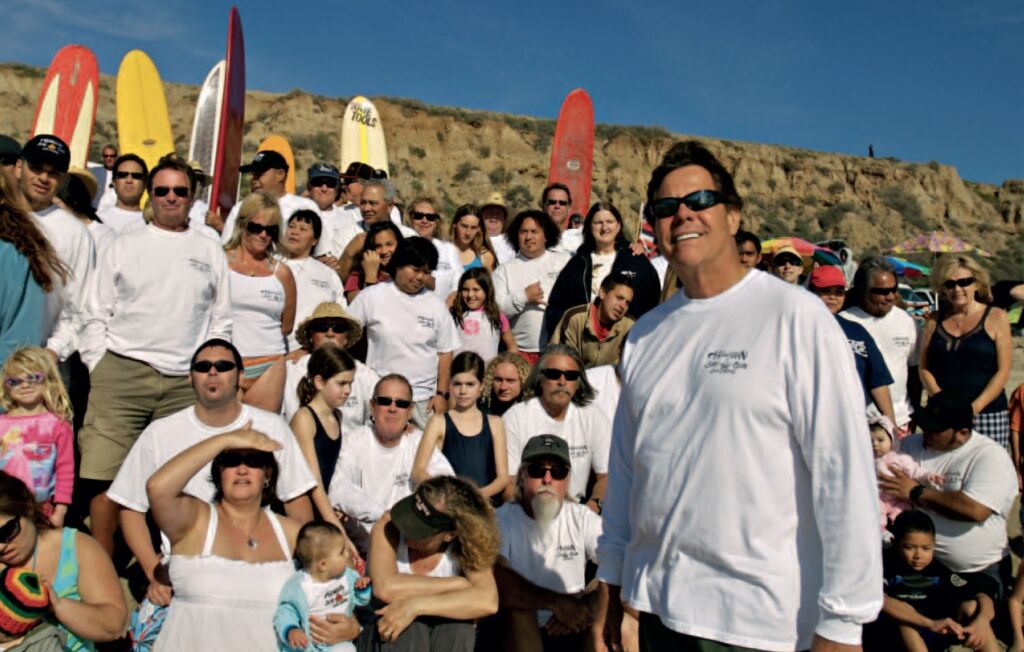
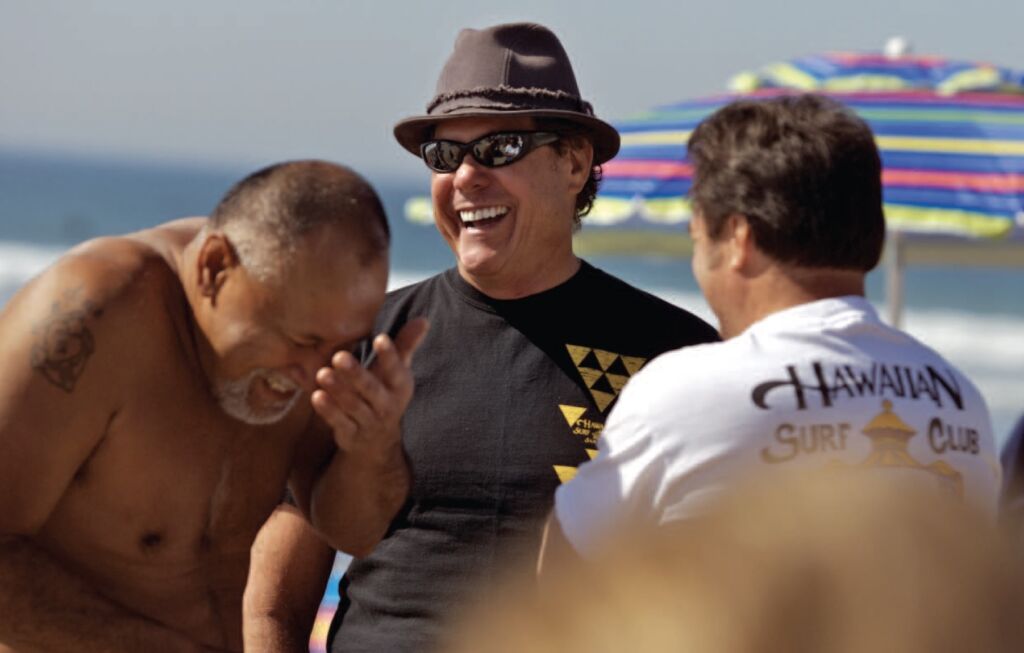
SP You’ve been a leader in the surfing community in recent years. I don’t know if you see yourself in that role, but you obviously invest yourself in helping the Hawaiian Surf Club and others in various ways.
PSJ I’ve never thought of it in that way. I knew some of the club’s founding members very well, like Raymond Patterson and Frank Marasco. They, along with other transplanted Hawaiians who surfed and wanted to come together to ride waves and share the camaraderie and their Hawaiian lifestyle—music and food—formed the Club in 1990. I was invited to come into the Hawaiian Surf Club because I’m a surfer from Hawaii and half Hawaiian. Other people admired what they were doing and asked how they could become part of it and it grew. When I moved to California in the early ’90s, they asked me to help. I had a business background, loved to surf, Hawaiian music, and to eat. I remember at that time there wasn’t enough money in the club treasury to cover postage to send out the club minutes. But, that’s past and we have built an admirable reputation at San Onofre for having fun surfing and sharing Aloha and Hawaii’s culture. Personally, I wanted to share my Hawaiian background and the true Aloha spirit.
In Hawaii, number one is respect. It must be sincere. With respect, you start thinking less about yourself and more about other people. If you do that, you’re probably not going to get into trouble. I was raised this way. Like, for instance, the word Aloha means a lot of things to a lot of people. It can be used when giving someone a lei, and to say hello and good-bye, and to describe various generous and loving qualities of being. The word represents the combination of “alo” and “ha!” Literally translated into English, “Alo” means in the presence of, and “ha” means breath, or breath of life. The Hawaiians upon greeting one another would put their foreheads together and touch noses, look eye to eye, and say simply “Ha” (with a sharp push of air from the lungs). As one expresses their breath of life and the other does the same, each consumes the other’s life energy. I believe in Aloha. It’s not just a word. It is a way of life, and I’m just trying to share this lifestyle with others. I think it helps to contribute to someone else’s happiness. Matter of fact, I know it does.