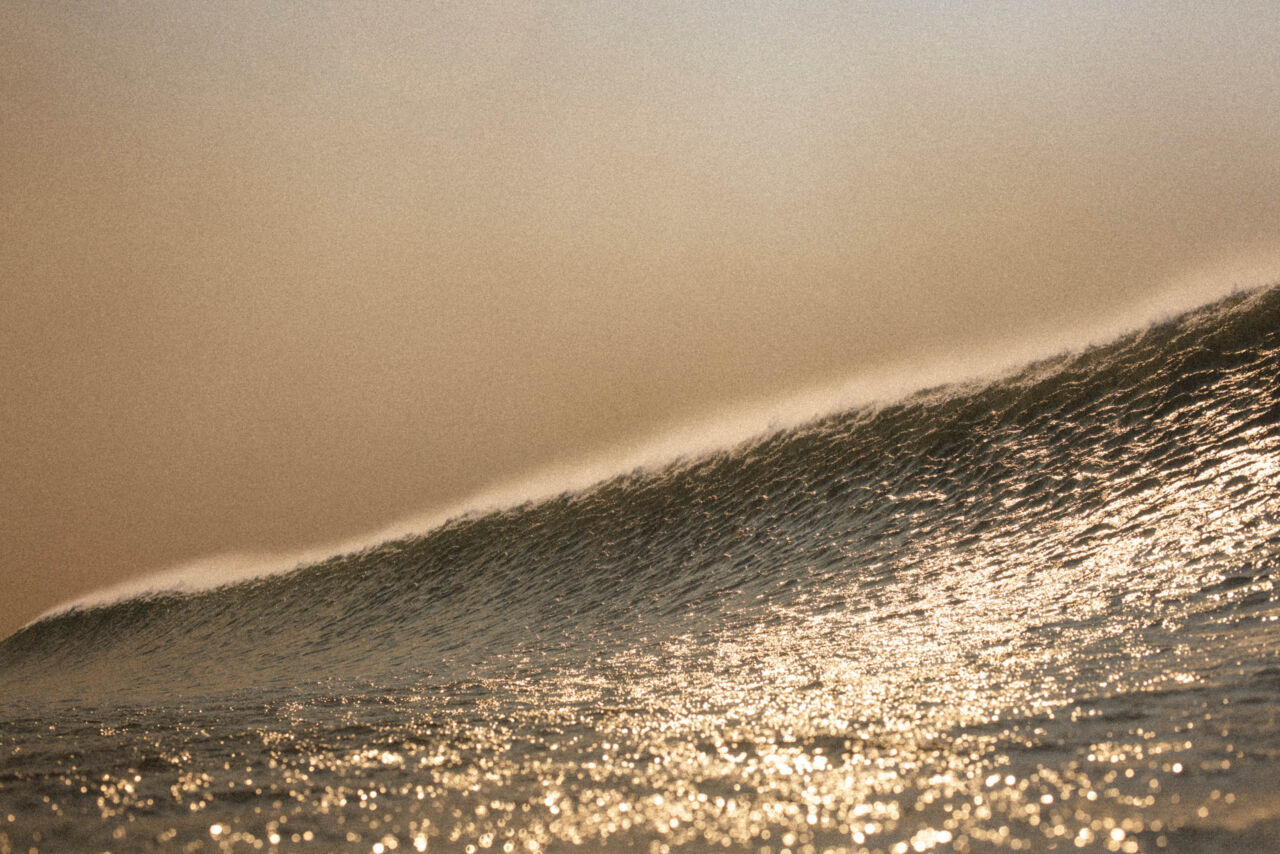
Mid-ocean swells don’t cause water molecules to move until reaching the shallows. Instead, they are expressed as pulses of rotating, circular, rhythmic energy radiating outward through the ocean. As windstorm sets progress farther outward, their groupings continue to evolve and define themselves, gathering size, spacing, and even elegance.
According to the strength and duration of the causal winds, swells may range in strength from relatively minor to overwhelmingly gigantic. As the stronger ones traverse vast stretches of sea, they eventually encounter shorelines or other stationary obstacles in their path.
Wave riding entails all the complexities of the universe. In its totality, it is all-encompassing. In its detail, it is fractionated into bits of life and matter that, to surfers, define in each particle why they exist in a conscious state, what they perceive, and how they might use it.
Most desirable are waves with open “green-water” shoulders and steep, speedy sections with an evenly peeling curl line. Becoming intimate with the wave phenomenon by repeatedly playing within its sphere of habits and aberrations creates a sense of relationship with the progenitor of this expression of natural energy. None of this is on a surfer’s mind when in the act, but it can increasingly underlie one’s persona as years pass.
The necessary confluences cause surfable waves to be perceived as rarified perfections. These are to be found along shorelines of our globe that present approaching swells with a particular functional combination of bottoms and angles. Those that do become celebrated and enjoyed, both above and below the sea surface, by mammals of many types, we humans being just one.
[Feature image by Erin Feinblatt]